Summary: Nearly every enterprise runs AI pilots. Very few run AI in production. The gap is rarely the model. It’s memory, integration, governance and the infrastructure underneath, and this is what to fix first.
There’s an odd pattern in enterprise AI right now. Adoption is close to universal. Production is close to rare.
The number everyone quotes comes from MIT’s NANDA research, reported in August 2025: around 95% of generative AI pilots fail to produce measurable business value. The stated reason isn’t model quality. It’s that most tools “cannot retain feedback, adapt to context, or improve over time”.
Gartner is blunter about what comes next. In a June 2025 forecastit expects over 40% of agentic AI projects to be cancelled by the end of 2027, citing “escalating costs, unclear business value or inadequate risk controls”.
Both point the same way. The demo isn’t the hard part.
A working demo and a working system are different animals
Pilots succeed under conditions production never offers. Clean sample data, a friendly evaluator, one workflow, no auditor, no load, and no consequence when the thing gets it wrong.
Production reverses every one of those. The agent meets messy records, concurrent users, an identity model, a retention policy, and somebody whose signature is required before it touches anything real. What looked impressive in a meeting room becomes a system that has to be operated on a Tuesday afternoon when two people are on leave.
Buyers should also know the market is noisier than it looks. Gartner describes widespread “agent washing”, which it defines as “the rebranding of existing products, such as AI assistants, robotic process automation (RPA) and chatbots, without substantial agentic capabilities”. Its estimate: only about 130 of the thousands of agentic AI vendors are real.
A pilot proves that the agent can work. Production proves whether the organisation around it is ready.
The four gaps that actually stop agents
The first is memory, and it’s the failure MIT identified. An agent that can’t retain what happened last time repeats the same mistake indefinitely. Without a path from correction back into retrieval or fine-tuning, month six looks exactly like week one, and the business case quietly dies of boredom.
The second is integration. An agent that can’t read the ERP, write to the CRM or raise a ticket is a chat window with good manners. Value shows up when it acts inside systems of record, and that means connectors, service accounts, rate limits and error handling. Unglamorous engineering that no demo ever shows.
The third is governance, which Gartner names as “inadequate risk controls“. Security and legal will want to know who the agent authenticates as, what it can reach, where the data goes, and whether every action is logged and reversible. “The model decided” is not an answer that survives an audit.
The fourth is infrastructure, and it’s where the economics live. Pilots run on somebody’s credit card. Production runs on capacity planning: token cost at scale, GPU availability, latency, egress, data residency. All of it decided by the platform underneath, which is why “escalating costs” is the first cause Gartner lists.
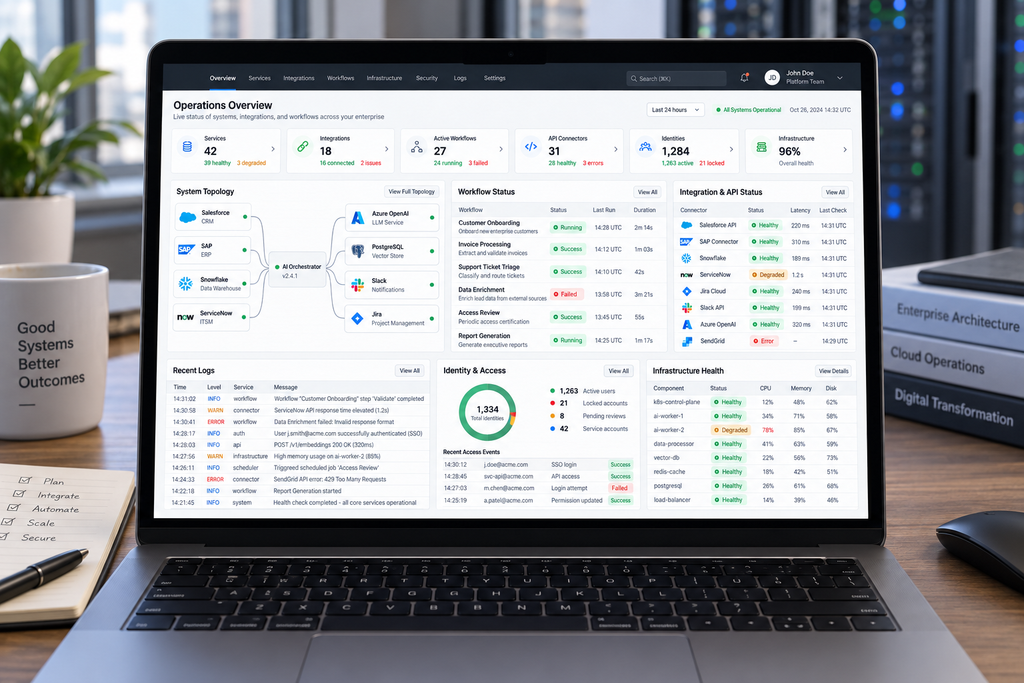
Behind every production AI system is a layer of integrations, permissions, logs, and infrastructure.
Pilot conditions vs production conditions
Dimension
Pilot
Production
Data
Curated sample
Live, messy, permissioned
Identity
Shared test account
Per-user, least privilege
Failure
Try again
Incident, rollback, audit trail
Cost model
Unmetered experiment
Cost per task, budgeted
Improvement
Manual prompt edits
Feedback loop into retrieval
Approval
One sponsor
Security, legal, compliance
Success measure
It looked impressive
Baselined, measured, defensible
What we’ve learned building the layer underneath
Most of our AI work isn’t the agent. It’s the platform that lets an agent survive contact with an enterprise: identity, network isolation, data pipelines, GPU capacity, logging, and the security posture wrapped around all of it.
Three habits separate the deployments that reach production from the ones that get a nice slide at year end.
Pick a task with a number attached. Not “improve productivity”, but something with a current cost, a current duration and a current error rate, baselined before anything gets built. Without a before there is no after, and no defence when finance asks what changed.
Ground it, then constrain it. Retrieval against approved sources keeps answers inside material the organisation will actually stand behind. Add least-privilege access and full logging and “what might it say?” becomes a question with a bounded answer.
Decide where it runs before you build it. Managed cloud, sovereign cloud or your own GPU cluster isn’t a late hosting detail. It sets cost, latency and whether the deployment is legal for the data involved, which in this region is often the binding constraint rather than a preference.
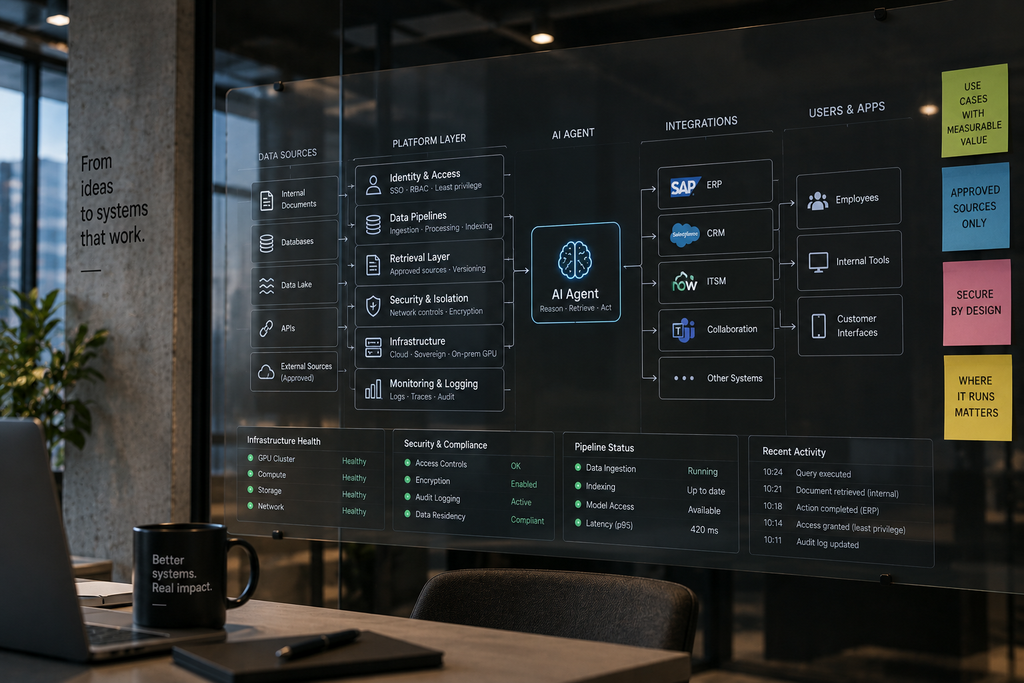
Production AI depends on the operating layer underneath the agent: identity, data pipelines, approved sources, infrastructure, logging, and security controls.
The honest read on those forecasts
You could read “95% fail” and “40% cancelled” as proof the whole thing is hype. To be fair, plenty of people have. But the same Gartner forecast expects 15% of day-to-day work decisions to be made autonomously by 2028, up from zero in 2024, and a third of enterprise software to include agentic AI, up from under 1%.
Both things are true at once. The technology is going to matter, and most of today’s projects won’t be around to see it. The difference is almost never the model. It’s whether anyone built the plumbing.
MIT’s NANDA research found around 95% of generative AI pilots fail to deliver measurable value, because most tools cannot retain feedback, adapt to context or improve over time. The blocker is usually memory, integration and governance rather than model quality.
What is agent washing?
Gartner’s term for rebranding existing products – AI assistants, RPA and chatbots – as agentic AI without substantial agentic capability. Gartner estimates only about 130 of the thousands of agentic AI vendors are genuine, so vendor due diligence matters more than usual.
How do you prove ROI on an AI agent?
Baseline a specific task before building: current cost, duration and error rate. Measure the same things afterwards. Without a documented before there is no defensible after, and “escalating costs, unclear business value” is the most common reason projects get cancelled.
Should AI agents run in the cloud or on-premises?
It depends on the data. Managed cloud is fastest to start; sovereign cloud or an on-premises GPU cluster may be required where data residency rules apply. Decide before building, because it determines cost, latency and legality, not just hosting.
What makes an agent production-ready?
Grounding against approved sources, least-privilege identity, integration with systems of record, complete logging of every action, a feedback loop that improves retrieval, and a cost per task you can budget against.
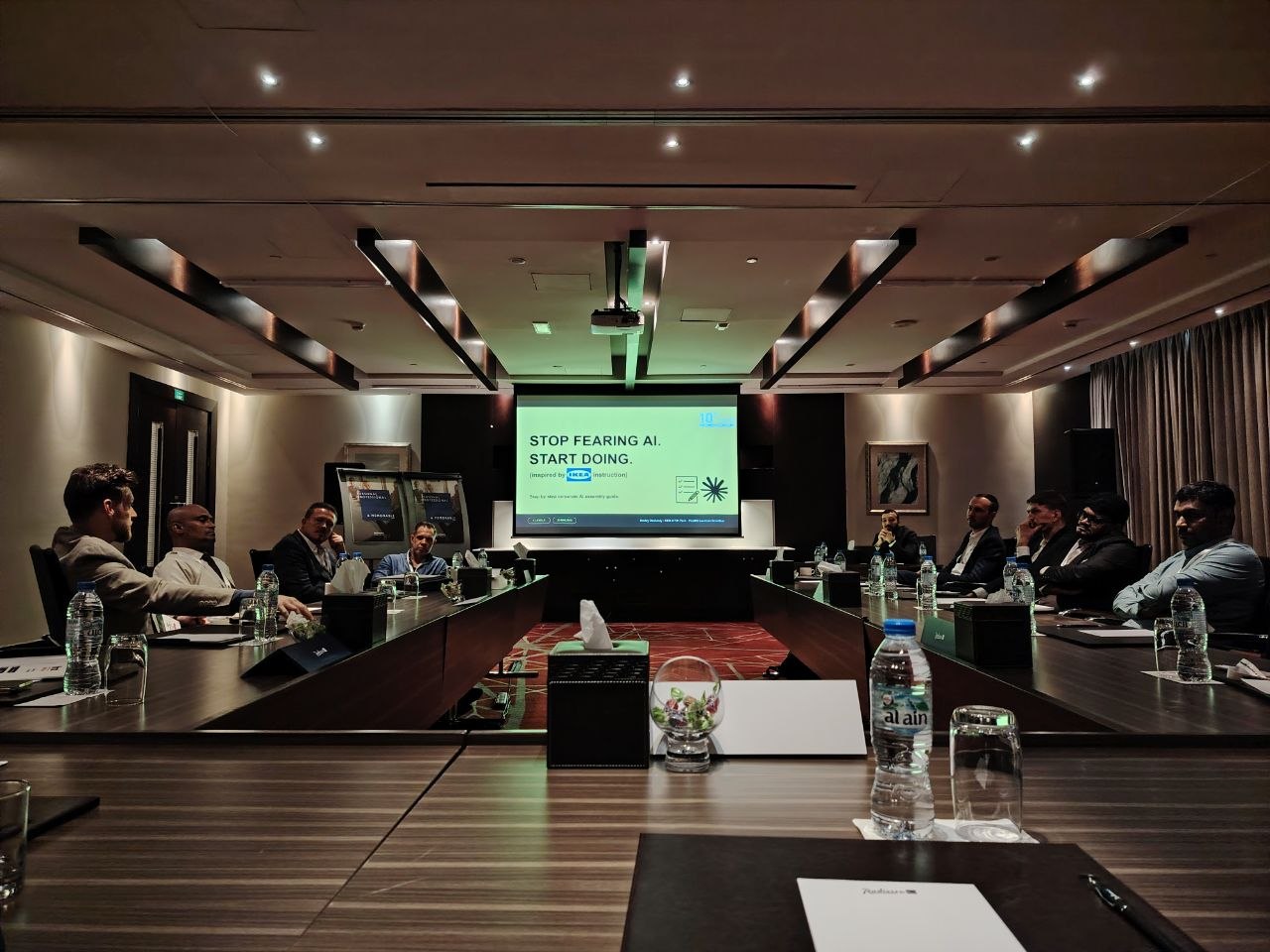
This week I spoke at a business breakfast in Dubai, to a room of construction and contracting executives. Good coffee, and the kind of audience that has heard “AI transformation” often enough to have developed antibodies.
That word is most of the problem. Transformation is what we call a thing when nobody knows the first step. It implies a program, a budget line, an outside consultant and a steering committee that meets every second Thursday until everyone quietly loses interest. Nobody transforms a wardrobe. You assemble it on a Saturday, from a diagram that assumes nothing about your expertise, using one allen key that is somehow the wrong size.
So I wrote the talk as assembly instructions instead.
The format is not mine. Ruben Hassid published a free guide calledHow to start with Claude, written as IKEA instructions. At the end of my slides I pointed the audience to his guides. What I added is everything that comes after one person gets good at this: the company, the security, the data platform, and the part where two hundred employees need access and your infosec lead has questions.
An independent format homage, by the way. Not affiliated with IKEA.
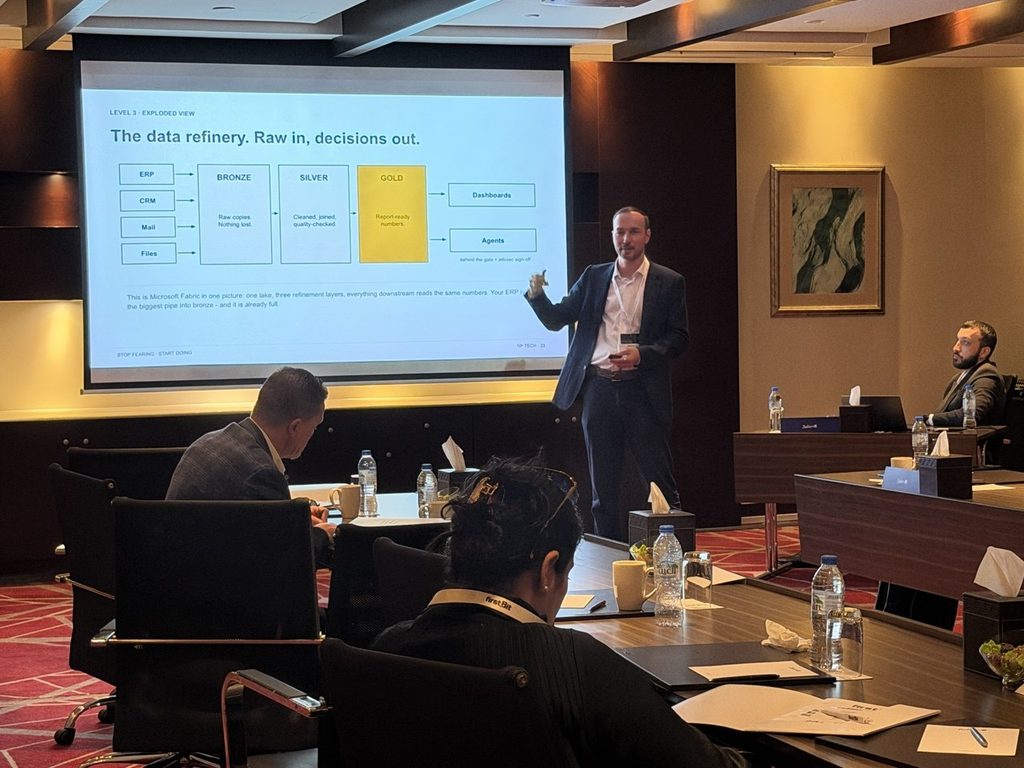
Dmitry Doshaniy speaking at a FirstBit business breakfast in Dubai on practical AI adoption for business leaders.
Before the first prompt
Five fears turn up in every one of these rooms. Our data will leak. It makes things up. The regulator will not like it. Our data is a mess. It will replace my people.
All five have answers. None of the answers is “wait and see.”
The number everyone quotes as a reason to wait
You have seen the statistic. Ninety-five percent of AI pilots fail.
That is not what the study found. MIT’s NANDA report, published in July 2025, found that 95% of organisations reported no measurable P&L impact from their AI pilots. The authors put that down mainly to companies having no baseline and no way to evaluate results, rather than to the technology underdelivering. They described their own figures as directionally accurate, and the headline number has been challenged since, largely for how narrowly it defined success.
Read properly, it is a measurement failure, not a technology failure. Most companies never set up a way to tell whether anything worked.
Which is worth putting next to Thomas Watson Jr., who ran IBM from 1956 to 1971:
I never varied from the managerial rule that the worst possible thing we could do would be to lie dead in the water with any problem. Solve it, solve it quickly, solve it right or wrong. If you solved it wrong, it would come back and slap you in the face and then you could solve it right. Lying dead in the water and doing nothing is a comfortable alternative because it is without immediate risk, but it is an absolutely fatal way to manage a business.
Solve it wrong and the slap is information. Never measure and no information ever arrives.
Parts list
Nothing here is exotic, and most of it you already own.
For you, one weekend
One executive sponsor, which is you. One strong-model seat on a business plan, not a personal one. One folder of text files that explains your company to it. One harness, which is the thing that turns a chat window into something that finishes work.
For the company, one quarter
Seats for everyone who touches company data. One gateway in front of them, armoured. Your ERP and the cloud tenant you already pay for. One infosec lead with a seat at the table from day one, which is what makes the regulator conversation boring. Boring is the goal.
Zero coding. Zero data scientists. Zero forty-page AI strategy documents.
The assembly sequence
AI adoption runs in four levels, and you cannot skip one. Level zero is you, one weekend. Level one is your team, one month. Level two is the organisation, one quarter. Level three is the regulated core, a year, in waves.
Level three built on level-zero habits is a demo. Level three built on a gate is a system.
AI adoption works best in levels: individual habits first, then team use, organisation-wide governance, and finally the regulated core.
Level zero: the weekend
Pick the strong model rather than the fast one. End your prompts with five words that change everything: “ask me questions first.” Give it goals, not tasks. Then create one project and load your context into it.
That last one sounds technical and isn’t. All the context everyone talks about is a folder of text files. Who you are, how you write, what you charge, what happened this week. If you can write a memo you can build context. Notepad works.
The harness
A chat answers and stops. A model with a harness finishes the job, because it can open your files, use tools, follow your rules, and check its own output before it comes back.
My favourite way to explain this is Memento. The man wakes up every morning with no memory, so he leaves himself notes, and the notes are what let him function. That is a language model at nine in the morning. Fully capable, remembers nothing about you. The files are the notes.
The model is the engine, the harness is the car, and you drive. The good part, the part I did not expect: you can build the car while driving it. This deck took months of evenings and it built most of itself.
The harness turns a model from a chat interface into a working system, with files, tools, rules, and a loop for checking output.
Level two: the gate
Somewhere around level two you discover your staff did not wait for permission. They already paste company text into personal accounts, on their phones if the office network blocks it. Personal accounts on most vendors train on that data by default. There is a toggle, and I would not bet the company on how many people found it.
So one gate goes in front of everything. One login, one policy, every model behind it. Personal data stripped before a prompt leaves the building, token budgets per team, every call logged. Your CFO gets one bill instead of forty personal subscriptions surfacing on expense reports.
Business plans do not train on your data. That alone is a reason to make the company account the easy option. And the review of what you are exposing is a cybersecurity healthcheck conversation rather than an AI one.
Level three: data before agents
The pattern that works in regulated industries is dull and it is the whole trick. Do not start with AI, start with data.
One regulated financial group brought us twenty-five use cases and no data platform. We sorted them into waves. Dashboards on clean data first, no machine learning at all. Then regulatory reporting. Then predictions. Agents last, on purpose, behind the gate.
Someone asks about local models in every one of these rooms. It is possible, and we run it for government clients, but the trade-offs are real: smaller models, less context, and reports you wait fifteen minutes for. If your data genuinely cannot leave the country, that is a self-hosted enterprise AI question and the shape of the build changes.
If you run construction, the good news is that the raw layer already exists and you are sitting on it. BOQs, payment certificates, timesheets, actuals. Your ERP is the data platform you think you do not have.
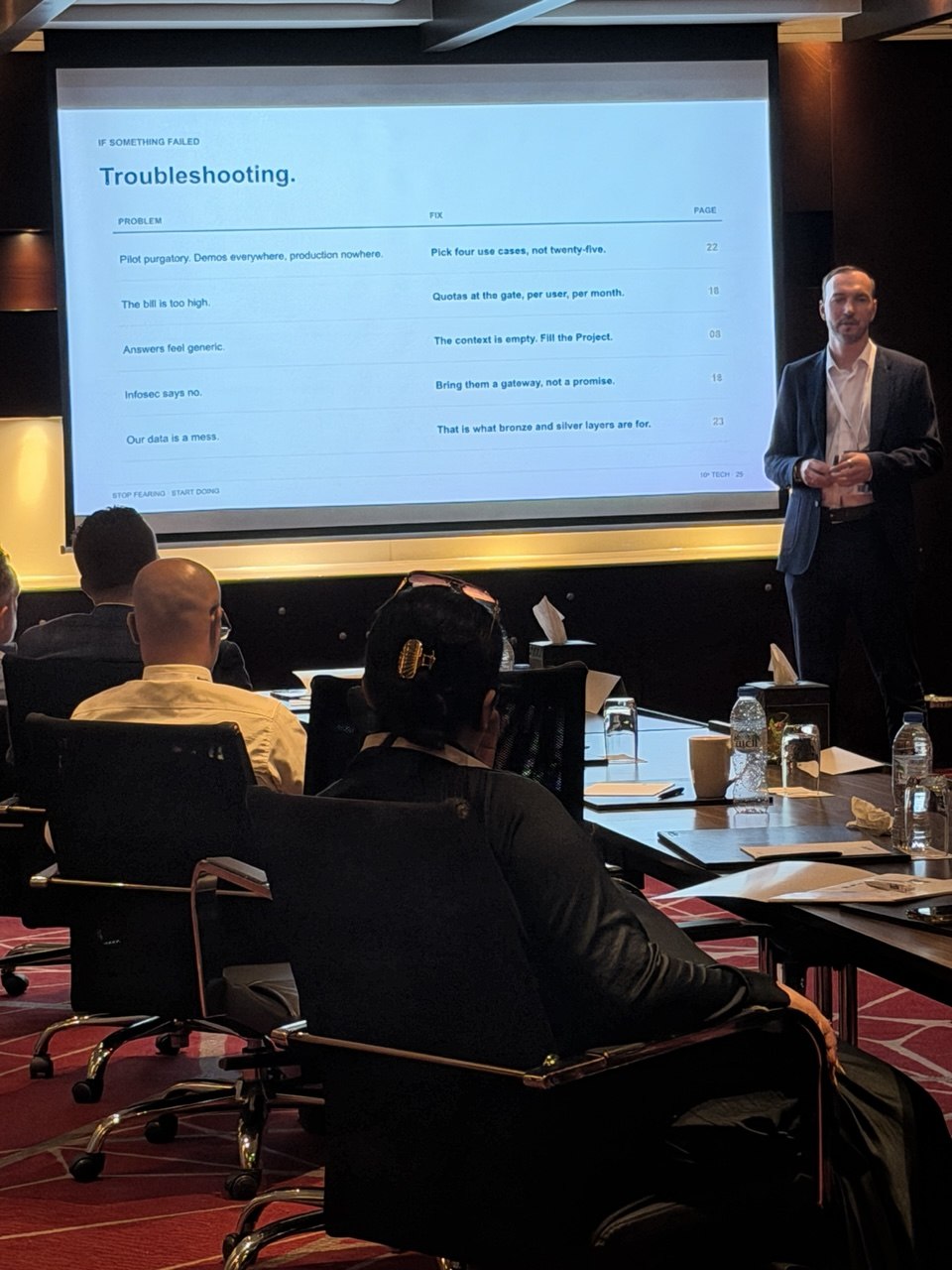
Troubleshooting
Problem
Fix
Pilot purgatory. Demos everywhere, production nowhere
Pick four use cases, not twenty-five
The bill is too high
Quotas at the gate, per user, per month
Answers feel generic
The context is empty. Fill the project
Infosec says no
Bring them a gateway, not a promise
Our data is a mess
That is what the bronze and silver layers are for
Common AI adoption blockers usually have practical fixes: fewer use cases, better context, clearer governance, and stronger data foundations.
Why I think this is worth your weekend
For a long time I paid for a contractor arrangement that never quite delivered. Automation work around our CRM, permanently almost-finished. It ended around the time I started using Claude Code properly, and inside two months I had built everything I had ever asked for, plus a fair amount nobody had thought to ask for.
Our whole team plan costs a few hundred dollars a month, and rather less than that arrangement did. I am not going to pretend the maths is difficult.
One more piece of evidence, since executives reasonably ask where the enterprise money is actually going. Anthropic now leads enterprise LLM API market share, 40% against OpenAI’s 27%, and 54% against 21% in enterprise coding specifically, according to Menlo Ventures’ December 2025 research. OpenAI is far bigger in consumer subscriptions. The business-process work is going elsewhere, and that tells you something about where the value is being found.
This is too important to delegate. You cannot appoint someone to be transformed on your behalf.
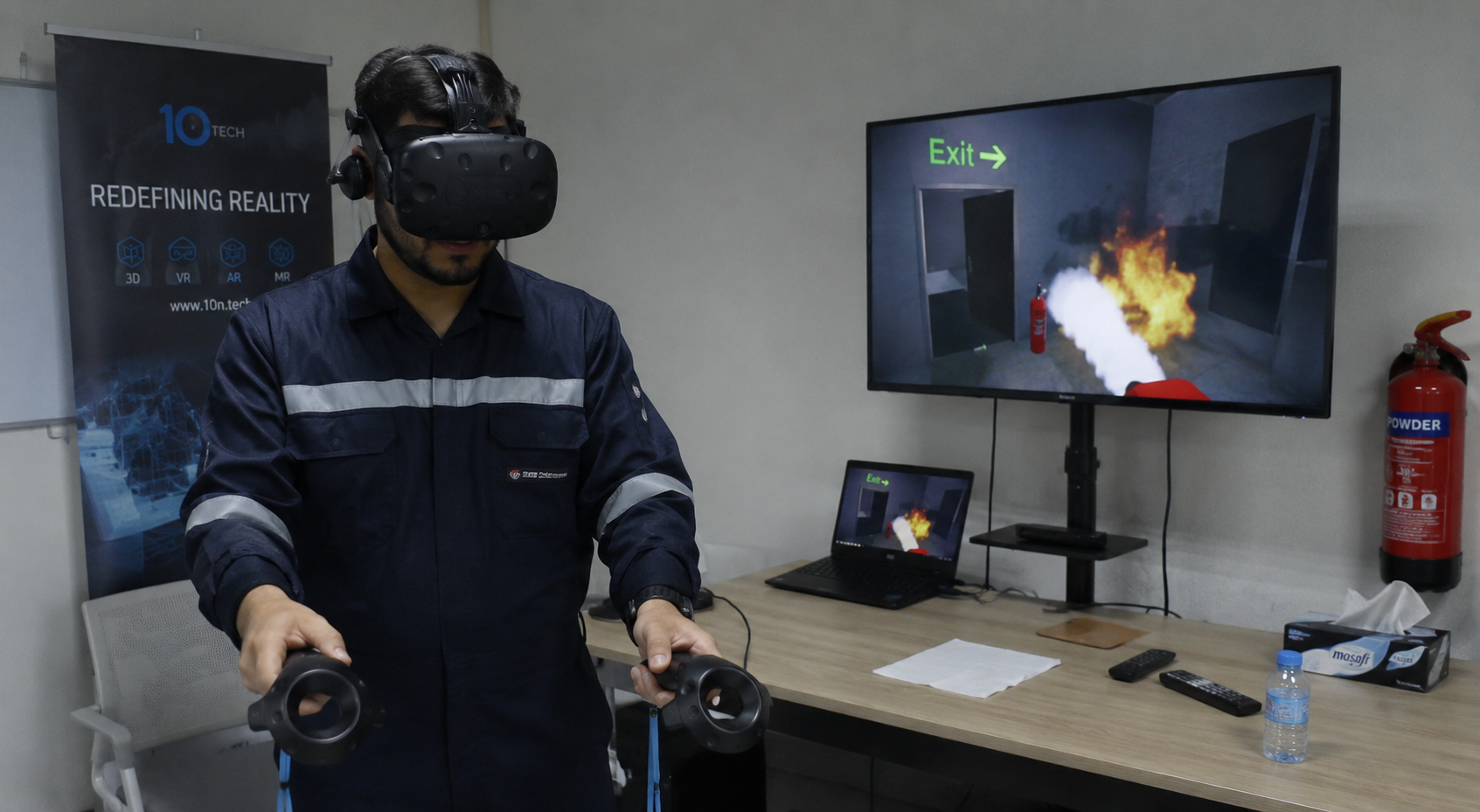
Summary: In oil & gas, most incidents trace back to human factors – and the classroom is a poor place to prepare for a real one. This is what we learned building VR HSE training around the IOGP Life-Saving Rules across more than 20 industrial simulation projects: what makes it work, the mistakes that make it fail, and a simple test for when VR is worth it.
In oil and gas, the equipment is engineered to fail safely. People are the variable.
The International Association of Oil & Gas Producers (IOGP) attributes close to 40% of upstream incidents to human factors, and around 80% of well-control incidents to human error. Across heavy industry more broadly, the figure is higher still. That is not a training-attendance problem. It is a training-transfer problem: people can pass a written test on a procedure they have never performed under pressure.
We’ve built VR HSE training for oil and gas operators, gas-processing contractors and national energy companies, as part of more than 20 industrial simulation projects. Here’s what we learned about doing it well, and where it goes wrong.
Start with the Life-Saving Rules, not a nice-looking scene
The most common mistake is building an impressive VR environment with no safety spine. The environment isn’t the point. The behaviour is.
The strongest oil & gas programmes we have built are structured around the IOGP Life-Saving Rules – the ten controls that prevent the majority of fatalities:
Work authorisation (valid permit)
Working at height (protect against a fall)
Energy isolation (verify isolation and zero energy)
Confined space (authorisation before entry)
Line of fire (never enter it, or a moving part)
Hot work (control flammables and ignition)
Safe mechanical lifting (plan the lift, control the area)
Toxic gas (follow the rules for toxic environments)
Driving (safe driving, seatbelt on)
Bypassing safety controls (authorisation before override)
Each rule becomes a scenario the trainee actually performs, not a slide they read. That framing matters for buyers too: it maps training directly to the controls their auditors and regulators already care about.
Effective VR HSE training turns safety rules into task-based scenarios that trainees must complete step by step.
The D.I.C.E test: when VR is actually worth it
VR is not the right answer for every course. We use a simple filter, and we share it with clients before quoting anything. Build VR training when the traditional kind is D.I.C.E:
Dangerous – a fire, a toxic release, a line-of-fire event you can never stage on a live asset.
Impossible – a scenario that cannot be reproduced without shutting the plant down.
Counterproductive – training that would disrupt production or occupy the people you are trying to protect.
Expensive or rare – a procedure that happens once a year, or on equipment that costs a fortune to take offline.
If a course is none of those, a good classroom session or a checklist may be enough. Being honest about this is what earns the trust to do the parts that genuinely need VR.
What actually makes oil and gas VR training work
Four lessons show up on every project that works.
Build a defect system, or trainees memorise the film. If the scenario runs the same way every time people learn the sequence rather than the skill, so we add variable defects: noise, vibration, leaks, a valve that behaves differently today. The trainee has to read the situation, not recall it. That single design choice is the biggest difference between a demo and a training tool.
Test on the way in and on the way out. An entrance and exit assessment turns a nice experience into evidence, and it lets you show a supervisor exactly how a trainee’s accuracy and response time moved. It’s also what justifies the spend when somebody asks.
Design for the field, not just the headset. Not everyone trains in one. The programmes that scale run the same scenarios on a headset, a kiosk, a tablet and a workstation, so a remote crew or a control room mid-shift can still get through them.
Lean into emotion, because that’s where retention comes from. PwC’s study of VR training found learners were up to 275% more confident applying what they’d learned, and trained up to four times faster than in the classroom, largely because they felt the situation rather than watched it. In safety training that emotional weight is the feature, not a side effect.
Scenario variation forces trainees to read the situation, make decisions, and respond correctly instead of memorising a fixed sequence.
What it looks like in practice
The pattern repeats across sectors. For a national oil company we built a VR simulator for equipment operation and assembly. For a gas-processing contractor, work-at-height and lifting scenarios with haptic feedback. For an oil-service company, an onboarding simulator that walks a new hire through a five-year well lifecycle in about thirty minutes.
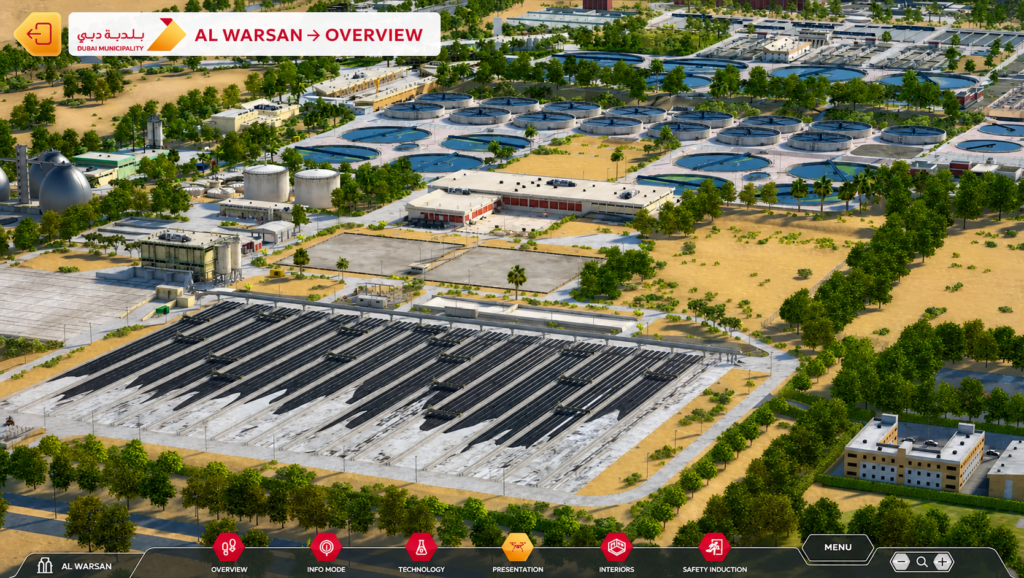
The clearest public example is Dubai Municipality, where the operator-training platform for two sewage treatment plants included three full emergency scenarios – fire, flood, and blackout – alongside VR maintenance training on real equipment. Control-room and field teams could rehearse the worst day of their careers with nobody at risk. (For the operator-training side of that work, see How digital twins improve industrial operator training.)
Dubai Municipality’s operator-training platform allowed teams to rehearse emergency scenarios inside a digital replica of their facility environment.
Where VR HSE training fits alongside everything else
VR does not replace toolbox talks, permits, or on-the-job mentoring. It replaces the gap between “I have read the procedure” and “I have done it.” Used for the D.I.C.E cases – the dangerous, impossible, disruptive, and rare – it is the most direct way we have found to move human-factor incidents in the right direction.
The best programmes treat VR as one layer in a wider safety system: built to the Life-Saving Rules, measured on the way in and out, delivered across devices, and refreshed as procedures change. Get those four right and the technology mostly disappears, which is exactly what you want.
Frequently asked questions
Why use VR for oil and gas HSE training instead of classroom sessions?
Because most serious incidents come down to human factors, and the classroom cannot reproduce a fire, a toxic release, or a line-of-fire event. VR lets crews perform the response, repeatedly and safely, which is what builds competence rather than just knowledge.
What are the IOGP Life-Saving Rules, and how do they fit VR?
They are the ten controls that prevent most oil and gas fatalities – work authorisation, working at height, energy isolation, confined space, line of fire, hot work, safe lifting, toxic gas, driving, and bypassing safety controls. Each becomes a VR scenario the trainee performs, which maps training directly to the controls auditors and regulators expect.
Does VR training actually improve safety outcomes?
It improves the two things that drive outcomes: competence and confidence under pressure. PwC found VR learners up to 275% more confident and four times faster to train. Combined with entrance and exit assessments, that gives measurable evidence a crew is ready.
When is VR training not the right choice?
When a course is not dangerous, impossible, disruptive, or rare (the D.I.C.E test). For low-risk knowledge that a classroom or checklist covers well, VR adds cost without much benefit. The value is concentrated in the scenarios you cannot safely stage any other way.
How do you stop trainees just memorising the scenario?
With a defect system – variable noise, vibration, leaks, and equipment behaviour – so the situation changes each run. The trainee has to read and respond, not recall a fixed sequence.
Summary: The test of any training is not what people remember in the room. It is what they do on the job, under pressure. This is what actually transfers from VR training compared with the classroom – the evidence, an honest side-by-side, and where each approach still earns its place.
Here is an uncomfortable fact about most corporate training: an employee can attend the session, pass the test, sign the sheet, and still freeze the first time it matters.
That gap, between knowing a procedure and performing it under pressure, is what training is supposed to close. It’s also what the classroom struggles with most. So the honest question isn’t whether VR beats the classroom. It’s what actually transfers to the job.
We’ve built more than 20 industrial VR training programmes, alongside plenty of ordinary courseware. Here’s what we’ve learned about the difference.
Knowledge is not competence
The classroom is good at one thing: transferring knowledge. It explains what should happen, in what order, and why. For understanding a concept, it is efficient and cheap.
But knowledge is not competence. Competence is the ability to do the right thing, in the right sequence, when the alarm is going off and the pressure is real. That is built by doing, repeatedly, with consequences – which is exactly what a lecture, a video, or an e-learning module cannot provide. The learner stays a spectator.
In high-risk work this is not a soft distinction. The ASM Consortium puts the cost of abnormal situations in the US petrochemical industry alone at billions a year, and around 40% trace back to human error. When the gap between knowing and doing has consequences that large, “they attended the course” is not good enough.
Up to 275% more confident to act on what they had learned.
Up to four times faster to train than in the classroom.
3.75 times more emotionally connected to the content than classroom learners.
Up to four times more focused than their e-learning peers.
The confidence and emotion numbers are the ones that matter for transfer. People remember what they felt, not what they were told. Large enterprises running VR at scale have reported similar gains in retention across their programmes. The mechanism is well understood in the research as presence – when an environment feels real enough, the brain responds as if it is real, so the learning attaches to the situation rather than to a slide.
VR vs classroom vs e-learning: an honest comparison
No single method wins on every axis. This is roughly how they compare for skill-based, high-stakes training:
Dimension
Classroom
E-learning
VR training
Transfers knowledge
Strong
Strong
Strong
Builds competence under pressure
Weak
Weak
Strong
Emotional engagement / confidence
Medium
Low
High
Measurable proof of competence
Subjective
Completion only
Objective (scored actions)
Training speed
Baseline
Faster
Up to 4x faster
Cost per learner at low volume
Low
Very low
Higher (build cost)
Best for
Theory and concepts
Broad, low-risk knowledge
Dangerous, rare, hands-on skills
The pattern is clear: the classroom and e-learning are excellent for understanding; VR is where capability is built – and where you can actually prove it.
What we have learned makes VR transfer
Not all VR training transfers. The programmes that do share three habits.
Vary it. If the scenario runs identically every time, people memorise the film rather than learn the job, so we build in variable defects: noise, leaks, vibration, a valve that behaves differently today. The trainee has to read the situation instead of recalling a sequence. Without that, VR is just a nicer video.
Test at both ends. An entrance and exit assessment is what turns an experience into evidence, because task accuracy and response time before and after are the only proof that competence actually moved. That’s the part a supervisor, an auditor or a CFO will trust.
And keep it for the right jobs. VR earns its cost on the dangerous, the impossible and the rare: a fire response, an emergency shutdown, a confined-space entry. For low-risk theory the classroom is still the cheaper and better answer. Using VR everywhere is how programmes lose credibility, usually about eighteen months in.
The answer is usually “both”
The strongest training we have delivered is not VR instead of the classroom. It is a blend: the classroom and e-learning for the knowledge, VR for the competence that has to hold up on the worst day.
At Dubai Municipality, operators still learn theory conventionally – then rehearse fire, flood, and blackout in VR, on a replica of their own control system, until the response is automatic. The classroom told them what to do. The VR made sure they could do it. (More on that operator-training work in How digital twins improve industrial operator training.)
If you only remember one thing: judge training by what transfers to the job, not by what fills the room. On that test, for the skills that carry real risk, VR is hard to beat.
Frequently asked questions
Is VR training really more effective than classroom training?
For skill-based, high-stakes training, yes – because it builds competence, not just knowledge. PwC found VR learners up to 275% more confident to act and up to four times faster to train. For pure theory, the classroom is still efficient and cheaper.
Does VR training improve knowledge retention?
It improves the durability of skills because learning attaches to a felt experience rather than a slide – the “presence” effect. Enterprises running VR at scale report higher retention, and entrance/exit assessments let you measure the gain directly.
When should we still use the classroom or e-learning?
For concepts, background knowledge, and low-risk procedures where understanding is enough and the cost of a mistake is low. The classroom and e-learning are efficient there; VR adds cost without much benefit.
How do you prove VR training actually worked?
By scoring performance on the way in and on the way out – task accuracy, response time, missed steps – and tracking improvement across sessions. That turns a training experience into auditable evidence of competence.
Can VR replace hands-on training entirely?
No. It closes the gap between knowing a procedure and having performed it, so people reach real equipment better prepared. It works best as one layer in a blended programme, not a total replacement.
Summary: Most VR training pilots do not fail on technology. They fail on the business case – the champion cannot justify the spend to management. This is how we scope a VR training pilot that proves ROI: the one task to pick, the pre-project survey to run, the metrics to fix up front, and the phasing that keeps risk small.
Almost every VR training pilot that stalls, stalls for the same reason: not the technology, the business case. The champion is convinced. Their management is not, because nobody agreed in advance what “success” would look like or how it would be measured.
We have scoped and delivered more than 20 industrial VR simulation projects. The ones that turn into rollouts all did the same unglamorous thing first: they treated the pilot as a business-case exercise, not a technology demo. Here is how to do that.
Step 1: pick one task – the right one
The instinct is to model the whole facility. Resist it. A pilot exists to prove value on the smallest scope that can carry a convincing result.
Pick a single task that fails the D.I.C.E test – where traditional training is Dangerous, Impossible, Counterproductive, or Expensive/rare:
A high-risk manual procedure (an emergency shutdown, a confined-space entry).
A task you cannot safely stage on the live asset.
Training that would disrupt production or tie up your best people.
A rare, high-consequence event nobody gets enough real practice on.
One task, one clear training gap, one measurable outcome. That is a pilot. Everything else is scope creep dressed up as ambition.
The strongest pilots start with one critical task, one training gap, and one measurable outcome.
Step 2: run a proper pre-project survey
The pilot’s credibility is set before a single scene is built, in the survey. This is where you turn “we want VR training” into defensible functional and technical requirements. In our projects the input mix looks roughly like this:
~30% task cards, regulations, and operating procedures – the ground truth of how the job is actually done.
~20% an in-person survey of the process, with photos and video of the real equipment.
~20% existing training methodologies and materials – what already works, what does not.
~10% interviews with the people who will actually use it.
~10% occupational-safety regulations and approaches.
~10% IT infrastructure and how the simulator will integrate with corporate systems.
The output is not a mood board. It is an analytical report, a feasibility view, the functional and technical requirements, the specific training scenarios, and – critically – the KPIs. Skip this and you get an impressive demo that no auditor or CFO will trust.
A strong pre-project survey turns a VR idea into functional requirements, training scenarios, and measurable KPIs.
Step 3: fix the metrics before you build
ROI is only provable if you decide, in advance, what you will measure. The metrics that consistently carry a business case are simple:
Time to complete a scenario – how the learning pace improves over sessions.
Task-fulfilment accuracy – the percentage of actions performed correctly.
Trainees per month – how throughput changes once training no longer needs the live asset.
Error and incident reduction – the safety outcome the whole thing exists for.
Downtime avoided – training that no longer takes equipment offline.
Onboarding time – how fast a new hire reaches competence.
Baseline these under the current method first. Without a “before”, there is no “after”, and no ROI story.
ROI becomes easier to prove when performance is measured before and after the pilot.
Step 4: phase it so risk stays small
A well-scoped pilot is staged, with a client sign-off at each gate rather than one big leap of faith. A typical shape:
Scope and design – requirements, scorecard, scenario design, sign-off.
Build – the simulator and its scenarios.
UAT – the client tests against the agreed scorecard and accepts.
Go-live – production release and first training cohort.
Support and measure – collect results against the Step-3 metrics, then decide on scale.
Each gate is a decision point. Nobody is asked to bet the whole programme up front, which is exactly what makes the “yes” easier to get.
The ROI math is not subtle
Two numbers carry most business cases. First, the cost of the incidents you are trying to prevent: the ASM Consortium puts abnormal situations in one industry alone at billions a year, most traced to human error. A single avoided shutdown or safety event can outweigh an entire training programme. Second, training efficiency: PwC found VR learners train up to four times faster – which is fewer instructor hours, less equipment downtime, and faster onboarding, every cohort. Put a real cost against your current training day and the pilot usually pays for itself before it scales.
What a well-scoped pilot looks like
A Gulf electricity and water utility came to us to modernise how it trains high-voltage cable jointers – a precise, high-risk manual task where a mistake is dangerous and expensive, and live practice is limited. That is a textbook D.I.C.E case: one critical skill, a clear gap, a measurable outcome, and a natural path to scale (the same platform later extends to more procedures and integrates with the utility’s wider digital plans).
That is the shape to aim for. Not “let us build a digital twin of everything.” One high-risk task, scoped properly, measured honestly, and staged so the risk stays small – proven, then expanded.
As small as possible while still proving value – one high-risk task, one training gap, one measurable outcome. Modelling the whole facility is the most common way pilots overrun and lose their business case.
How do you prove ROI on VR training?
Baseline your current training first, then measure the same things after: scenario completion time, task accuracy, throughput, error/incident reduction, downtime avoided, and onboarding time. Set these metrics before building, or there is nothing to compare against.
What does a VR training pilot actually cost to justify?
The two levers are avoided incidents (often worth more than the whole programme) and training efficiency – PwC found VR up to four times faster, which cuts instructor hours, downtime, and onboarding time each cohort. Put a real number on your current training day and the comparison is usually clear.
How long does a VR training pilot take?
It is phased – scope and design, build, user-acceptance testing, go-live, then measurement – with a client sign-off at each gate. Staging it this way keeps the risk (and the decision) small at every step.
Which task should we choose for the pilot?
Use the D.I.C.E test: the training that is Dangerous, Impossible, Counterproductive, or Expensive/rare to run conventionally. That is where VR delivers the clearest, most defensible result.
Summary: Sovereign AI gets discussed in gigawatts. The question an architect actually faces is narrower: which of our data is legally required to stay in-country, and what does that force us to build? Here is the practical answer, including what the hardware really costs and how long it takes to arrive.
The headline version of sovereign AI is enormous. G42 confirmed in October 2025that Stargate UAE is a 1GW cluster in Abu Dhabi, built with OpenAI, Oracle, NVIDIA, Cisco and SoftBank, with delivery from 2026.
Good news, and largely irrelevant to the question most architects are being asked this quarter. Which is simply: can this workload legally run where we want to put it?
For a lot of GCC data, that’s already written down.
Sovereignty is a legal requirement before it’s an architecture
The UAE’s general regime is Federal Decree-Law No. 45 of 2021, which sets the conditions for moving personal data across borders. Free zones layer their own rules on top, and DIFC runs under Data Protection Law No. 5 of 2020.
But the sharpest rule is sector-specific. Federal Law No. 2 of 2019 on ICT in health fields, Article 13, says this:
“It is not permissible to store, process, generate or transform the health data and information outside State – which are related to the health services provided inside State – except in the case where a resolution is issued from the Health Authority in coordination with the Ministry.”
Now read that against a typical AI proposal. “Store” is obvious enough. The word that catches people is “process”, because inference is processing. Sending a patient record to a model endpoint hosted in Ireland isn’t a grey area under Article 13. Neither is training on it.
That’s why these conversations start in healthcare, government and defence, then spread outward. Once one workload is pinned in-country, everything around it inherits the constraint.
Sovereign AI in the GCC starts with a practical question: which workloads can legally move, and which must stay in-country?
“Sovereign” means at least four different things
Vendors rarely say which one they’re selling. Data residency means the bytes sit in-country, which is the weakest guarantee and the one most often quoted. Operational sovereignty is about who can reach the system and from which jurisdiction, and residency counts for very little if a support desk three time zones away holds the keys.
Legal sovereignty asks whose courts and disclosure regimes reach the operator regardless of where the disks spin. Technical sovereignty is the awkward one: if the vendor relationship ended tomorrow, could you still run this? That means model weights, not hosting.
Most tenders ask for the first and quietly assume the other three. That assumption is where projects get stopped late, after the architecture is already signed off.
Three deployment models, honestly compared
Dimension
Managed cloud AI (in-region)
Sovereign / private cloud
On-prem GPU cluster
Time to first workload
Days
Weeks
Months
Data residency
In-region, operator-run
In-country, controlled
Fully in your estate
Operational sovereignty
Depends on support model
Strong
Complete
Model weights
Vendor-controlled
Yours or hosted
Yours
Capex vs opex
Opex only
Mixed
Capex-heavy
Cost at sustained load
Highest
Middle
Lowest per token
Who fixes it at 3am
The provider
Shared
You, or your MSP
Best for
Experiments, bursty use
Regulated data at moderate scale
Restricted data, steady heavy load
What we see most often isn’t a single choice. It’s a split: general workloads on managed cloud, the regulated subset pinned to sovereign or on-premises capacity. Usually cheaper than forcing everything into the strictest tier, and easier to defend in an audit.
Most enterprise AI architectures will not rely on one deployment model. The practical answer is often a split between managed cloud, sovereign cloud, and on-prem capacity.
Buying the accelerators is not the easy part
There’s a comfortable story in which GPUs are a line item and the real work is elsewhere. That story is wrong, and it wrecks project plans.
A single 8-GPU B200 or B300 server lands somewhere around USD 600,000 to 700,000 depending on configuration and who you buy through. That’s one node. Lead times have been running at roughly six months, sometimes longer, which means the hardware decision sits on the critical path from the day the project charter is signed rather than at the end of it. We’ve had BOMs where the delivery date, not the design, set the go-live.
Two consequences follow. Budget approval has to clear a capital number most IT committees don’t see in a normal year. And your architecture has to be fixed early, because you can’t reorder in month four when someone changes their mind about the model size.
The regulatory side has just moved in the UAE’s favour, though. On 10 July 2026 the US Bureau of Industry and Security removed the UAE from Country Groups D:3 and D:4 and reclassified it as Country Group A:5, the most favourable tier. Under the US-UAE AI Cooperation framework signed in May 2025, Commerce also approved the UAE Government and certain companies to receive advanced computing items licence-free, “including AI chips and servers”.
That matters commercially. It removes a licensing step that used to add months of uncertainty, and it puts the UAE in a small group of countries where this hardware can be bought without a case-by-case approval. It does not make the servers cheaper, and it does not make the queue shorter. Supply is still supply.
What else gets underestimated
Power and cooling come first. Dense AI racks change power draw per rack, cooling strategy and floor loading, and plenty of colocation contracts written for ordinary enterprise workloads simply cannot take them without a renegotiation nobody budgeted for.
Then the fabric between the nodes. At multi-node scale the east-west network decides whether the cluster performs anywhere near its spec sheet, and under-specifying it is the quietest way to waste the largest capital line in the whole project.
Day-2 is the one people skip. A sovereign platform is only sovereign if somebody in-country can patch it, monitor it, restore it and prove they did. Sovereignty without an operating model is a compliance statement waiting to fail its first audit.
And treat the inference endpoint as what it is: a data-access path. Private endpoints, no public model surface, least-privilege identity, an audit trail of every call. The same discipline you’d apply to any system holding the crown jewels, because that’s effectively what it now touches.
A sovereign platform is only sovereign if it can be operated, monitored, secured, restored, and audited in-country.
A sensible order of decisions
Classify the data. Which categories carry a residency obligation, and which genuinely don’t.
Name the sovereignty you need, in the requirement rather than the marketing.
Size the steady-state load. Bursty work favours managed cloud; sustained inference favours owned capacity.
Start the hardware conversation now, not after design sign-off, because six-month lead times make procurement a design constraint.
Agree who patches, who restores and who evidences it for the auditor.
National-scale capacity is arriving either way. The organisations that get value from it will be the ones that already know which of their workloads can legally move, and which never could.
It covers four different guarantees: data residency (where the data sits), operational sovereignty (who can reach it and from where), legal sovereignty (whose courts reach the operator) and technical sovereignty (whether you could still run it without the vendor). Most tenders ask only for residency and assume the rest.
Does UAE law require AI data to stay in the country?
For health data, yes. Article 13 of Federal Law No. 2 of 2019 prohibits storing, processing, generating or transforming health data related to services provided inside the UAE outside the State, except by resolution of the Health Authority. Because inference is processing, that covers sending records to a model endpoint hosted abroad. Personal data more generally falls under Federal Decree-Law No. 45 of 2021.
What does a GPU server cost and how long does it take to arrive?
An 8-GPU B200 or B300 server runs roughly USD 600,000 to 700,000 depending on configuration, with lead times around six months. Both facts matter for planning: the capital number needs approval most IT committees are not used to, and procurement sits on the critical path rather than at the end of it.
Has it become easier to buy AI chips in the UAE?
Yes. On 10 July 2026 the US Bureau of Industry and Security reclassified the UAE into Country Group A:5, removing it from Groups D:3 and D:4, and approved the UAE Government and certain companies to receive advanced computing items licence-free, including AI chips and servers. That removes a licensing step, but it does not reduce price or lead time.
Can we mix sovereign and public cloud AI?
Yes, and it is usually the most economical answer: general workloads on managed cloud, with the regulated subset pinned to sovereign or on-premises capacity. Forcing everything into the strictest tier normally costs more than it needs to.
Most serious industrial incidents come down to human error, but the live plant is the worst place to practise for one. An industrial digital twin gives operators a working virtual replica of the plant and its control system, so they can rehearse normal operations and emergencies, prove their competence, and cut downtime – without touching production. This guide explains how it works, shows a Dubai Municipality example, and sets out how to start with a focused pilot.
Most serious process incidents are not caused by broken steel. They are caused by people, under pressure, making the wrong decision at the wrong moment.
The scale is easy to underestimate. The ASM Consortium, an industry group formed to study abnormal situations in process plants, estimates that these events cost the US petrochemical industry at least USD 10 billion a year, and that around 40% of them stem from human error. In highly automated plants, where hardware rarely fails on its own, the human share of failures runs higher still.
You cannot close that gap with a manual. And the obvious place to build the skill – the real facility – is also the worst place to practise. Training on live industrial equipment can interrupt operations, expose people and machinery to risk, and limit the scenarios instructors can recreate. A plant cannot be flooded, shut down, or pushed into a dangerous condition simply to test how a trainee responds.
That leaves industrial companies with a poor choice: provide realistic training and accept disruption, or protect production and rely on classroom learning that may not prepare people for real conditions.
An industrial digital twin removes the choice. It lets operators and maintenance teams train on a working virtual replica of the plant, its processes, equipment, and control systems – rehearsing normal operations and emergencies, and proving competence, without touching the live facility. It is an approach 10ⁿ Tech has already delivered at municipal scale, training more than 150 operators for Dubai Municipality’s Jebel Ali and Al Warsan plants (more on that below).
Why Traditional Industrial Training Has Limits
Most industrial training programmes combine classroom instruction, written procedures, observation, and supervised practice. Each method has value, but each also has limits.
Written materials explain what should happen. They don’t reproduce the pressure of a live incident.
Videos show a procedure, but the employee stays a spectator throughout.
Hands-on training is more practical, though it often means taking equipment out of service, and it puts new employees into hazardous environments before they’ve built any confidence.
The gap is widest exactly where it matters most: emergency preparation. Employees often understand a procedure in theory without ever having performed the sequence under realistic conditions. The table below shows why no single traditional method covers the whole problem – and why a digital twin does.
An industrial digital twin is the only one of the four that lets teams rehearse the dangerous moments on the real interface, as often as they need, with a record of how they did.
What Is an Industrial Digital Twin?
A basic 3D model shows what a facility looks like. An industrial digital twin reproduces how it behaves.
The visual environment is only one layer. Underneath sits a dynamic model of the real process that calculates flow, pressure, temperature, dosing, equipment status and output. The twin can also connect to a replica of the facility’s actual control system: the same screens, mimic diagrams, alarms and operator panels the crew uses on an ordinary Tuesday.
When an operator changes a setting, shuts a valve, or responds incorrectly to a fault, the simulation reacts. Plant conditions update as they would in the real facility.
That is what turns it from a visualisation into a complete operator training simulator – one that supports safe learning, emergency rehearsal, and performance improvement. It is also why a generic simulator is not enough: operators who train on a generic system still have to relearn their own control room on day one. A digital twin of your plant and your control system removes that transfer gap.
Our work for Dubai Municipality shows what that looks like in practice: laser-scanned plant environments, mathematical process models, a distributed control system (DCS) replica, VR maintenance modules and assessment tools, all in one platform.
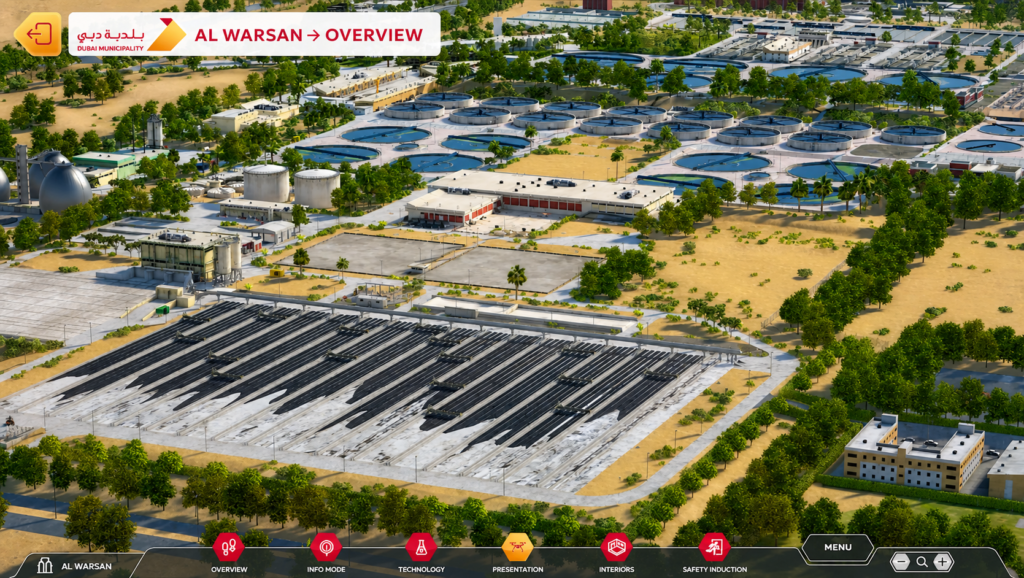
Al Warsan plant inside the Dubai Municipality industrial digital twin, showing how a real facility can be recreated as a training and simulation environment.
How an Industrial Digital Twin Supports Operator Training
An industrial digital twin gives employees access to a virtual version of the same system they are responsible for operating. A typical session follows five stages.
1. The instructor selects a scenario
The instructor can begin with normal operations, start-up, shutdown, equipment failure, or an emergency, tailored to the employee’s role and experience.
2. The trainee works through the real interface
The operator uses a replica of the plant’s DCS or other operational interface. This closes the gap between training and daily work – employees do not learn on a generic simulator and then face a different system in the control room.
3. The process reacts dynamically
The model recalculates conditions as the trainee makes decisions. A delayed action, wrong sequence, or incorrect setting produces real consequences inside the simulation, so the trainee sees how one decision ripples through the wider process.
4. Control-room and field teams work together
Industrial incidents rarely involve one person. A digital twin can place control-room operators, field technicians, and maintenance staff inside the same scenario, where they must communicate, coordinate, and follow the correct escalation.
5. Performance is recorded
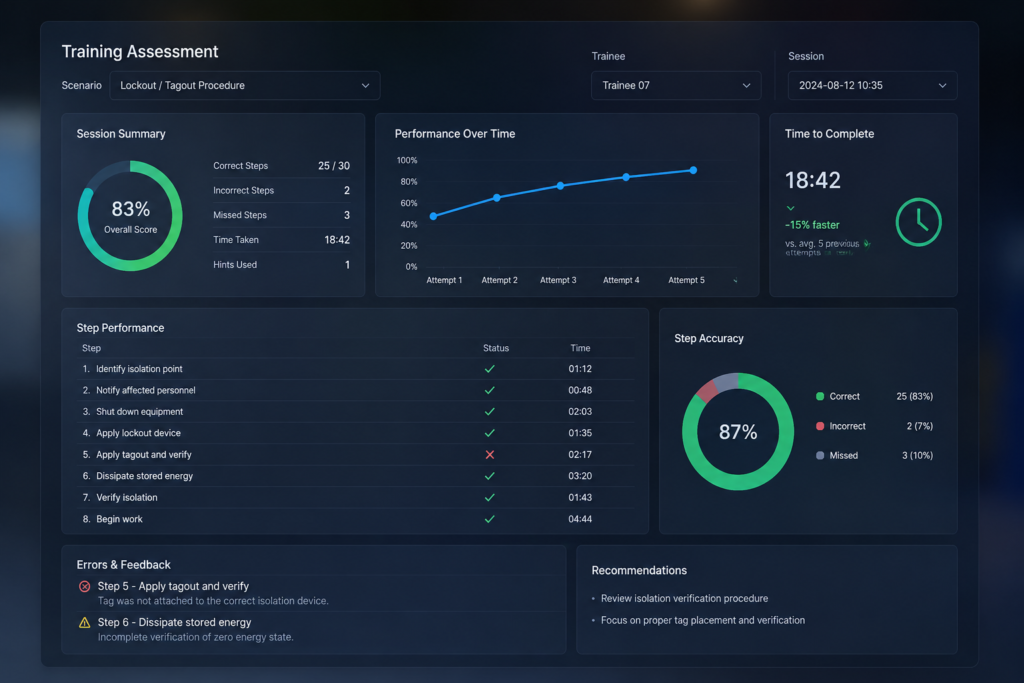
The platform records completion time, correct and incorrect actions, missed steps, and the outcome. Supervisors get measurable results instead of relying on observation or a written test.
Rehearsing the Moments That Cause the Most Incidents
The strongest case for a digital twin is not routine operation. It is the moments that are rare, dangerous, expensive, or impossible to reproduce in real life – and, tellingly, the process-automation industry reports that the number-one reason plants adopt operator training simulators is to make start-ups, shutdowns, and transitions safer. Those transitions are where incidents cluster, because the plant is moving between stable states and the operator has the least margin for error.
A digital twin lets teams rehearse exactly those situations:
Fire or flooding
Electrical failure and blackouts
Equipment malfunction and high-pressure incidents
Incorrect chemical dosing
Emergency shutdowns and start-up after a fault
Hazardous maintenance procedures
Coordination failures between field and control-room teams
Employees can repeat a scenario until their response becomes consistent. Instructors can then introduce variation – because a trainee who has memorised one sequence often struggles when conditions change.
The twin tests whether the operator understands the process rather than whether they can recite the steps. Rehearsing emergencies safely and repeatedly is the clearest way a digital twin improves safety without putting anyone, or the plant, at risk.
Use VR for Maintenance and Safety Training
Control-room simulation covers only part of industrial work. Maintenance teams must also inspect, disassemble, repair, and reassemble complex equipment – and in many facilities, access to the real machine is limited because it stays in operation or can only be opened during planned maintenance.
A VR maintenance module inside an industrial digital twin creates an interactive replica of the equipment. Technicians can practise the procedure step by step, identify components, learn the correct sequence, and see the consequences of mistakes before touching the real asset.
10ⁿ Tech’s VR training systems support both routine procedures and emergency response, and the results stay available to supervisors for review. This applies to pumps and compressors, decanter centrifuges, dryers, electrical and high-voltage systems, production machinery, confined-space procedures, oil and gas equipment, and water-treatment assets.
The aim is not to replace every form of practical training. It is to make sure people reach the real environment already understanding the equipment, the sequence, and the risks.
Reduce Downtime Without Sacrificing Training Quality
Industrial training carries costs that are easy to miss. A machine taken offline for instruction affects output. An experienced operator supervising a trainee isn’t doing their own job. And physical training rigs need space, maintenance and an update every time the plant changes.
A digital twin changes that arithmetic. Several employees train without stopping production, scenarios repeat without consuming materials or damaging anything, and the same platform covers onboarding, refreshers, assessment and emergency preparation. When equipment or procedures change, you update it rather than rebuild it.
The economics follow directly from the risk. Against the ASM Consortium’s figure – abnormal situations costing the industry billions a year – a single avoided shutdown or safety incident can be worth more than the entire training programme. For organisations running several sites, one standardised digital twin also delivers more consistent training across locations while reducing disruption.
Turn Training Into Measurable, Auditable Competence
Traditional training usually measures attendance and test completion. Neither proves that an employee can perform under pressure. An industrial digital twin can track:
Time to complete a scenario
Percentage of correct actions
Missed or incorrect steps
Number of instructor interventions
Response time to alarms
Compliance with the approved sequence
Coordination between team members
Improvement across repeated sessions
This gives managers a real view of competence – which procedures cause the most errors, which employees need support, and whether the programme is improving performance over time.
It also matters for compliance. Competence decays when a procedure is rarely used, and safety regimes such as OSHA’sProcess Safety Managementstandard require documented operator training and periodic refreshers. A digital twin makes refresher training and evidence of competence routine rather than disruptive, and the same records support internal certification, audits, and regulatory reporting.
Turn Training Into Measurable, Auditable Competence
A Real Example: Dubai Municipality
We developed industrial digital twins and operator training systems for the Jebel Ali and Al Warsan sewage treatment plants run by Dubai Municipality. Between them the two facilities handle around 675,000 cubic metres of wastewater a day.
The build was deliberately operational, not decorative: aerial and ground laser scanning, detailed 3D environments, a mathematical model of the treatment process, a replica of the distributed control system, and VR maintenance training for equipment including decanters, effluent pumps, and solar dryers. Control-room operators and maintenance personnel could train on normal and emergency procedures without creating any risk for the live plants.
According to the official Dubai Municipality case study, more than 150 employees were trained, and the two plants reported around 30% lower operational and maintenance costs, roughly 30% less equipment downtime, and about 30 additional productive minutes per employee each day. The value came from combining training, safety improvement, and operational efficiency in one platform – the same three outcomes every industrial operator is trying to reach.
Which Industries Benefit From Industrial Digital Twins?
Any sector where mistakes are expensive, facilities are complex, or live training creates risk.
Water and Wastewater
Practise treatment processes, dosing, equipment failures, blackouts, flooding, and emergency response without affecting water quality or availability.
Oil, Gas, and Petrochemicals
Rehearse start-up, shutdown, process faults, leaks, fire response, and hazardous maintenance – the sector where the ASM cost figures are highest.
Power and Utilities
Train control-room teams on network faults, equipment failures, switching, and emergencies using a replica of the real operational interface.
Manufacturing
Learn production sequences, machine operation, troubleshooting, maintenance, and safety without interrupting a line – often as part of a wider industrial metaverse.
Ports and Logistics
Support equipment allocation, container movement, berth planning, traffic flow, and coordination between operational teams.
Heavy Industry and Mining
Practise equipment operation, hazardous tasks, and emergency procedures where physical training is expensive or unsafe.
What Is Needed to Build an Industrial Digital Twin?
A useful twin must reflect the real facility, not a generic version. Starting materials typically include plant drawings, CAD and 2D documentation, process descriptions, equipment specifications, control-system information, standard operating and emergency procedures, training and assessment requirements, access for laser scanning, and input from experienced operators and instructors.
The team then connects several disciplines – 3D reconstruction, industrial process modelling, system integration, VR development, instructional design, and assessment. This is why an industrial digital twin should be treated as an operational system, not a visualisation project.
How to Start Without Modelling the Entire Plant
You do not need to reproduce the full facility at once. A focused pilot can begin with one high-risk process, one critical asset, one emergency scenario, one maintenance procedure, one control-room workflow, or one employee group with a clear training gap.
That keeps the initial scope small and builds a measurable business case. Define success criteria up front – reduced training time, higher assessment scores, fewer procedural errors, faster emergency response, lower dependence on live equipment, fewer instructor hours, better operator confidence. Once the value is proven, the platform expands to more processes, equipment, and locations.
The Goal Is Safer, More Efficient Operations
Industrial companies don’t need a digital twin because the term is fashionable. They need safer training, more capable operators, less downtime and fewer avoidable mistakes. When roughly 40% of costly abnormal situations trace back to human error, better-prepared people aren’t a soft benefit. They’re the point.
An industrial digital twin connects directly to those outcomes. It gives employees a place to practise before the real decision matters, gives instructors a better way to test competence, and gives management measurable evidence that people are prepared – all without disrupting production.
Summary: An AI trainer promises every trainee a personal tutor. The evidence for tutoring is real, but a lot smaller than the famous number suggests. Here’s what one actually delivers, where VR is still required, and the controls it needs before it goes near a regulated curriculum.
Every vendor pitching an AI trainer eventually reaches for the same statistic. Benjamin Bloom’s “two sigma” finding: one-to-one tutoring lifts achievement by two full standard deviations. It’s a wonderful number. It’s also, on the evidence, wrong.
Later work hasn’t reproduced it. AsEducation Next set out in 2024, a 1982 meta-analysis by Cohen, Kulik and Kulik put the average tutoring effect at about 0.33 standard deviations, and a 2020 meta-analysis by Nickow, Oreopoulos and Quan landed near the same place. Across the 96 tutoring studies reviewed, none produced a two-sigma effect. Brown University’s Matthew Kraft argued in 2020 that Bloom’s claim had “helped to anchor education researchers’ expectations for unrealistically large effect sizes”.
So the honest headline isn’t two sigma. It’s that tutoring reliably works at roughly a third of a standard deviation, which is a solid and repeatable gain that most corporate training never gets anywhere near. The reason organisations don’t offer it is cost. That’s the problem an AI trainer actually solves.
The constraint is economics, not pedagogy
Nobody seriously argues that a lecture hall beats a good instructor working with one trainee. It’s rare because instructor time doesn’t scale, and in specialist domains the instructors are the same people you need doing the actual work.
A well-built AI trainer changes the unit economics of something we already know works. It doesn’t have to beat your best human instructor. It has to beat what the trainee currently gets, which is usually a slide deck and an annual refresher nobody remembers by March.
The challenge is making it available to every trainee without scaling instructor time linearly.
Where it genuinely beats a classroom
Patience, first. Trainees will ask a machine the question they won’t ask in front of colleagues, and in safety training the unasked question is the one that turns up later in an incident report.
Consistency, second. Twenty instructors produce twenty slightly different courses. One grounded model gives the same answer in January and in November, which matters a great deal when the curriculum is regulated and somebody will eventually check.
Then availability. Shift workers don’t train at 10am on a Tuesday, and browser-based delivery reaches night shifts, remote sites and contractors without anybody building a schedule.
And assessment falls out of it for free. Every interaction is data: which questions recur, where people hesitate, which procedure is misunderstood across the whole workforce. A classroom produces an attendance sheet.
Unlike a classroom attendance sheet, an AI trainer can show where trainees hesitate, what they ask repeatedly, and which topics need reinforcement.
Where it doesn’t
An AI trainer teaches knowledge and judgement through dialogue. It builds no muscle memory whatsoever. You can’t talk somebody through a confined-space entry and then call them competent, and anyone who tells you otherwise is selling something.
That’s the boundary we draw on every programme. Conversational AI for the knowledge layer, VR simulation for procedures that have to hold up under pressure, real equipment for final sign-off. We’ve written before about what actually transfers from VR training, and the same logic runs in reverse here. Each layer is good at something the others aren’t.
Three training layers compared
Dimension
Classroom / e-learning
AI virtual trainer
VR simulation
Teaches knowledge
Strong
Strong
Moderate
Answers the individual question
Weak
Strong
Weak
Builds muscle memory
None
None
Strong
Cost per additional trainee
High
Very low
Low once built
Consistency across cohorts
Variable
High
High
Evidence generated
Attendance
Full interaction data
Scored actions
Best for
Background theory
Knowledge, Q&A, refreshers
Dangerous, rare, hands-on tasks
Each training layer has a different role. The strongest programmes use the right format for the right learning outcome.
The controls that make it deployable
For a government security programme or a regulated industrial curriculum, a general-purpose chatbot isn’t acceptable. Four controls decide whether the thing can be deployed at all.
It has to answer from the client’s own curriculum through retrieval, not from whatever the base model happened to absorb. If something falls outside the approved corpus the right behaviour is to say so rather than improvise, because in safety training a confident wrong answer is worse than no answer at all.
Curriculum changes need versioning. When a procedure is updated every trainee should get the new version immediately, with a record of who was taught which version and when. That record is precisely what an auditor asks for, and it’s usually the part nobody built.
Conversation alone isn’t evidence of competence, so scored assessment integrated with the LMS is what turns training into a defensible record.
And it usually has to run inside the client’s own estate. Curricula for security and safety programmes are sensitive, the interaction logs are arguably more revealing than the curriculum, and for some data categories in this region in-country processing is a legal requirement rather than a preference.
How to judge whether it worked
Completion rates measure compliance, not learning. The measures worth fixing before you build are the ordinary ones: assessment scores before and after, time to competence for a new hire, error and incident rates in the work itself, and how many questions the trainer answered that nobody would ever have asked a human.
Judged against a realistic benchmark, roughly a third of a standard deviation from good tutoring at a cost per trainee approaching zero, an AI trainer is a strong investment. Judged against two sigma it will disappoint every time. The number you promise at the start decides which of those you get measured by.
Does one-to-one tutoring really deliver a two-sigma improvement?
No. Bloom’s 1984 claim has not replicated. A 1982 meta-analysis by Cohen, Kulik and Kulik found an average tutoring effect of about 0.33 standard deviations, and a 2020 meta-analysis by Nickow, Oreopoulos and Quan reported a similar figure. Of 96 studies reviewed, none produced a two-sigma effect. Tutoring works, but at roughly a third of a standard deviation.
What is an AI virtual trainer?
A conversational training system grounded in the client’s own approved curriculum through retrieval, delivering one-to-one style tuition at scale in a browser, with assessment and certification integrated into the LMS.
Can an AI trainer replace VR or hands-on training?
No. It teaches knowledge and judgement through dialogue but builds no muscle memory. Use conversational AI for the knowledge layer, VR simulation for procedures that must be performed under pressure, and real equipment for final sign-off.
How do you stop an AI trainer giving wrong answers?
Ground it in the approved curriculum through retrieval rather than the base model’s general knowledge, and design it to say when something falls outside approved material instead of improvising. In safety training a confident wrong answer is worse than no answer.
Does an AI trainer have to run on our own infrastructure?
Often, yes. Curricula for security and safety programmes are sensitive and the interaction logs are revealing. For some data categories in the GCC, in-country processing is a legal requirement rather than a preference, which makes on-premises GPU deployment the only compliant option.
In this piece, Dmitry Doshaniy, CEO of 10ⁿ Tech, reflects on why AI and digital transformation investments so often fall short on the ground, and what actually moves a tool from pilot to everyday habit. Adapted from his conversation on the C-Suite Reflection with Nikita Jain, Co-founder and CEO of Eubrics AI.
Last week I was picking up my daughter from a play date. Her friend’s mother made the mistake of standing still long enough, and I spent thirty minutes explaining how AI could transform her small business. That is roughly my default state now. AI is in every conversation, at work and at home.
But there is a gap between how much we talk about AI and how much it actually changes on the ground. I joined Nikita Jain on the C-Suite Reflection to talk about that gap, and here is the longer version of what I think.
We are still at the very start
If you map AI onto the classic adoption curve, innovators, early adopters, the majority, the laggards, we are still with the early adopters. The innovators are making full use of it. Everyone else is watching.
What is unusual is the pace. AI reached its first billions of users in a handful of years. The telephone took decades. The internet took decades. But the shape of the curve itself is not set by the technology. It is set by us. Some people are natural risk-takers. Most are cautious. And if we were not cautious and risk-averse as a species, we would have gone extinct long ago. The big impact is still ahead.
Where transformation actually falls short
This is not an AI problem. It is a transformation problem, and it is an old one.
The research is blunt about it. IDC expects worldwide spending on digital transformation to pass two trillion dollars within a few years, and study after study finds that around 84% of those initiatives fail to deliver what they promised. They do not fail because the technology did not work. They fail on alignment, communication, and capability. North Carolina State’s risk management work puts resistance to change and legacy technology at the very top of the risk list for business today.
That matches what I see. The highest risk factors are resistance to change, legacy technology, and regulation, both government rules and a company’s own internal ones. And the root problem underneath all of them is that not enough planning goes into how the change will actually be delivered.
When these initiatives get scoped and budgeted, the focus is almost always technical. What are the building blocks. What software do we buy. Which engineers or contractors do we bring in. What rarely happens is communicating the impact early and engaging the actual end users early. So when the people whose work is about to change finally meet the new system, they ask the questions no one prepared them for. Is this a shiny new toy I do not need? Is it going to make me redundant? What happens to the relationships I have built around the old process?
Legacy technology is the same story wearing a different coat. Replacing a system is never just swapping hardware or software. There is a team that brought that system in years ago. They may still believe it is the right thing, and they may not want anyone running a project in their domain. Regulations work the same way. Someone wrote them, believed they were valid, and may believe they are still valid today.
Here is the honest version I give clients. In software, almost anything is possible. Name a task your organization needs to achieve and ask me if modern technology can do it, the answer is usually yes. But ask me how to achieve a specific transformation in your business, and the honest answer is “I do not know yet.” Not until we have done a proper feasibility study and mapped four environments: the existing technology, the regulatory landscape, the people, and the processes. Only then can we talk about how to make it work.
Getting everyone moving in one direction
Every person on a team sits at a different distance from AI. Some want to jump into everything. Some want nothing to do with it. So the first job is to answer one very simple question for each of them: what is in it for me?
To answer it, you have to stand in their shoes. Henry Ford put it precisely: “If there is any one secret of success, it lies in the ability to get the other person’s point of view and see things from that person’s angle as well as from your own.” When people can see how a tool helps them do their own work better, they come on board.
You also cannot discount the initial resistance. It will always be there, because we are wired against the new. So the introduction matters. Show how it is done. Pick a small pilot group, sometimes just one or two people who are naturally open and genuinely enthusiastic. Make them the champions, and make sure they sit at the same level as the people who are meant to adopt next.
This is the part most leaders get wrong. An excited manager is not enough. But when one or two peers start using the tool and their results visibly improve, and they share that with the team, something hardwired kicks in. Call it mirror motivation. We cannot stop ourselves yawning when someone near us yawns, and we copy the people around us, especially the ones we respect, especially when we can see it is working for them. Nobody wants to be left behind.
And you do not give up at the first friction. Early problems are inevitable as people learn. You hold the conviction that it will work, you point to the case studies of people who already made it work, and you give it time for the habit to form. When the new tool becomes a natural part of how things get done, that is when you can call it a success.
Change fatigue and the knowledge worker
A lot of people are tired. I hear it from learners and from L&D managers who say, fairly, “I was not trained for this, why is my manager pushing me toward agents?”
The only constant is change. For anyone in technology, this did not start yesterday. I have watched a large share of what I learned over twenty years become obsolete. You live in a constant cycle of unlearning and relearning. What used to take a year to go stale now takes a quarter. It is accelerating, and at times it is genuinely hard to keep up.
And yet I am an optimist. Statistically, this is the best time to be alive, lifespan, access, and opportunity all near their peak, and I expect new peaks ahead. This is not the first technology revolution and it will not be the last. Decades after the steam engine, after electricity, almost everyone was better off, even the workers who lit the gas lanterns and lost that job. The hard part is the adaptation in between, and that is the part we have to manage with care.
For knowledge workers specifically, there is no longer any separating yourself from AI tools, in the same way you cannot separate yourself from email or a word processor. You do not get to say you will write on paper and seal it in an envelope. Used properly, these tools help us do more, faster. The motto I give my team is simple: the goal is to work at the speed of thought. We are not far from it.
Crawl before you run
The most common mistake I hear is trying to run before you can crawl. You do not go from running an organization the traditional way to commanding hundreds of autonomous agents overnight, or even in half a year. You build the harnesses and the skills first.
From my automation engineering background, one law never changes: garbage in, garbage out. No amount of AI fixes bad data. If you cannot feed a model clean, validated information, it will not give you the right answer. It will try, it will say “sure,” and then it will hallucinate, and you will get failures you cannot explain. You start doubting the technology, and the project gets delayed or killed. So the data quality problem comes first.
The vision I am building toward is that everyone in an organization gets a team of assistants. Not all of them run around the clock. If you produce a quarterly report, you do not need an agent sitting in the cloud burning resources every day, you need a tool you run once a quarter. But if you want a daily read on what competitors are doing, then yes, while you sleep something crawls the web, processes it, connects to your CRM, and hands you a digest that is specific and actionable.
That last one is not theoretical. One of our target markets is real estate developers. We run a process that watches for new project announcements so we can reach a prospect before our competitors, with the right solution at the moment they need it, not half a year early, and not after they have already chosen an alternative.
Scaling beyond the pilot
Scaling AI past the pilot stage is a minefield, and there is no single mistake to avoid.
I still put the people factor first. Weak user adoption and weak advocacy for the change is the number one killer. But the technical traps are real too. Security gets stricter and the risk profile grows as more people get access. The context window becomes a bottleneck, push harder tasks and more data into a model and you can get less accurate results than you did at small scale.
There is an economic trap as well. I have heard of companies that mandated AI use and gamified it with token leaderboards, only for a finance chief to discover that the quarter’s entire IT budget had gone up in smoke. And it is a hard fact that the model providers are currently spending more than they earn. That cannot continue forever. At some point investors want a return, and I think it is close to inevitable that token costs rise from where they are now, absent another algorithmic breakthrough.
None of this is easy. But as I tell my team, people make money doing hard things.
Dmitry Doshaniy is the CEO of 10ⁿ Tech, a Dubai-based technology firm working across digital twins, enterprise IT, and applied AI for clients in the GCC, MENA, and beyond.
Reach out to 10ⁿ Tech
If your AI ambitions have outgrown the pilot stage, or the gap between what your teams should be doing with these tools and what they actually do every day has started to show, we are open to a conversation. You can reach out to our team.
10ⁿ Tech works with clients across digital twins, enterprise IT, and applied AI, helping teams turn complex technical needs into practical, deployable solutions.
In this piece, Dmitry Doshaniy, CEO of 10ⁿ Tech, shares a behind-the-scenes reflection on what it actually takes to rebrand a B2B technology company.
On the second day of June 2026, my mailing script was about to send hundreds of email announcements with 10n Tech in ASCII instead of 10ⁿ Tech in Unicode.
I caught it on the test send. Fifteen percent of the recipients would have read a slightly different name from the one we are bringing to the market.
That moment captured the whole rebrand in miniature. A new identity is a choice. Every interface where it appears – slide decks, email signatures, contract templates, CRM custom fields, Notion pages, LinkedIn profiles, invoice headers, supplier portals – is a separate decision to make the choice visible. Miss the choice in one place and the brand drifts back to the form it had before.
We came out the other side as 10ⁿ Tech. Below is what the exercise taught me about the company I run. I am writing this down because most rebrand content I have read sounds like it was written by someone who has not actually been through one, especially when .
The rebrand was not a marketing project. It was an audit.
We started by listing the visible things: logo, website, email domain, signature, deck templates. The list grew. We ended up reviewing every employment contract, every supplier mailbox, every NDA, every recurring vendor invoice, every CRM field with the old company name in a dropdown, every Notion page authored before March. The audit took longer than the design work.
If you are tempted to lead with the visual identity, do not. Lead with the inventory. The inventory is the hard part. The visual identity is the easy part.
The new name described what we had become, not what we had always been.
The old identity was associated with one category of work: digital twin platforms, immersive applications, real-time 3D for buyers and operators. That category is still our largest commercial line. But over the last few years the company had quietly grown into two more.
One is enterprise IT for environments where downtime is not a marketing word: industrial sites, healthcare, logistics, government. Storage, networking, container data centres, secure backup. Work that does not photograph well but pays.
The other is applied AI. Not AI as a website tag. AI as a thing we build: sales coaching agents that listen to call recordings and generate per-rep development plans, analytics layers on top of CRM and ERP that surface decisions instead of dashboards, conversational interfaces for internal operations.
The rebrand was forced by the gap between what people thought we did and what we were actually doing. Naming the gap was the most valuable part of the exercise, well before the first logo round.
Half the customers I talk to do not read English first.
The announcement campaign ran in two languages. The English version went out to clients and partners across the GCC and Europe, then came other languages we converse with the customers.
The lesson is broader than language. In B2B technology, the person who decides is rarely the person whose language the original marketing was designed in. Building for English-first content and translating later is the cheapest, worst version of multilingual operations. Building parallel tracks costs more and respects the audience more.
The Unicode mark is a real cost. I paid it anyway.
10ⁿ Tech uses U+207F, the Unicode superscript n. Microsoft Word handles it. Outlook handles it. Telegram and Slack render it. Some legacy CRM custom field validators do not. We had to write fallback rules for filenames, system fields, and certain integrations. The mark stays because the mark is part of the meaning: 10ⁿ is a scaling motion, not just nice sounding characters..
The principle generalises. Operational simplicity has its own gravitational pull. Resisting it for things that actually matter is most of what brand discipline is.
You cannot communicate a rebrand without your sales team. You have to ship them new tools.
Email templates. CRM field defaults. Pricing sheets. Demo scripts. Proposal templates. Cold outreach assets. If the new identity does not show up in the places where the actual work happens, the rebrand exists on the website and nowhere else. Salespeople will default to whatever is in their CRM and their template library. So the rebrand has to land there first.
The hardest decisions were about what to stop doing.
A rebrand is permission to retire the work the company has outgrown. We retired more than we added. Service lines that did not fit any of the three categories went into the archive. The press release did not mention what we stopped doing. The internal Notion page did.
The customer replies validated the rebrand better than the planning had.
Replies came in over the following days. Some asked about a new immersive showroom build. Some asked about industrial storage for a Gulf site. Some asked about an AI pilot. The pattern of replies told us the three-pillar move was not a marketing exercise. It was a description of what the customer relationship had already become.
I did not write this article to teach you how to rebrand.
We do not run rebrands for other companies. We build digital twin platforms, enterprise infrastructure for industrial and regulated environments, and applied-AI systems for operations and sales. The rebrand was an internal project that taught me something useful about the kind of company we have become.
If you have an immersive, industrial-IT, or applied-AI problem that has been sitting on your roadmap for a while, that is the conversation I would rather be in.
Dmitry Doshaniy is the CEO of 10ⁿ Tech, a Dubai-based technology firm working across digital twins, enterprise IT, and applied AI for clients in the GCC, MENA, and beyond.
Reach out to 10ⁿ Tech
If any part of this sounds relatable, especially the gap between what your company has become and what your systems or customer experience currently support, we are open to a conversation. You can reach out to our team.
10ⁿ Tech works with clients across digital twins, enterprise IT, and applied AI, helping teams turn complex technical needs into practical, deployable solutions.
Call Me Now
Leave your contact details and our specialists will contact you as soon as possible