
Summary: Nearly every enterprise runs AI pilots. Very few run AI in production. The gap is rarely the model. It’s memory, integration, governance and the infrastructure underneath, and this is what to fix first.
There’s an odd pattern in enterprise AI right now. Adoption is close to universal. Production is close to rare.
The number everyone quotes comes from MIT’s NANDA research, reported in August 2025: around 95% of generative AI pilots fail to produce measurable business value. The stated reason isn’t model quality. It’s that most tools “cannot retain feedback, adapt to context, or improve over time”.
Gartner is blunter about what comes next. In a June 2025 forecast it expects over 40% of agentic AI projects to be cancelled by the end of 2027, citing “escalating costs, unclear business value or inadequate risk controls”.
Both point the same way. The demo isn’t the hard part.
A working demo and a working system are different animals
Pilots succeed under conditions production never offers. Clean sample data, a friendly evaluator, one workflow, no auditor, no load, and no consequence when the thing gets it wrong.
Production reverses every one of those. The agent meets messy records, concurrent users, an identity model, a retention policy, and somebody whose signature is required before it touches anything real. What looked impressive in a meeting room becomes a system that has to be operated on a Tuesday afternoon when two people are on leave.
Buyers should also know the market is noisier than it looks. Gartner describes widespread “agent washing”, which it defines as “the rebranding of existing products, such as AI assistants, robotic process automation (RPA) and chatbots, without substantial agentic capabilities”. Its estimate: only about 130 of the thousands of agentic AI vendors are real.

The four gaps that actually stop agents
The first is memory, and it’s the failure MIT identified. An agent that can’t retain what happened last time repeats the same mistake indefinitely. Without a path from correction back into retrieval or fine-tuning, month six looks exactly like week one, and the business case quietly dies of boredom.
The second is integration. An agent that can’t read the ERP, write to the CRM or raise a ticket is a chat window with good manners. Value shows up when it acts inside systems of record, and that means connectors, service accounts, rate limits and error handling. Unglamorous engineering that no demo ever shows.
The third is governance, which Gartner names as “inadequate risk controls“. Security and legal will want to know who the agent authenticates as, what it can reach, where the data goes, and whether every action is logged and reversible. “The model decided” is not an answer that survives an audit.
The fourth is infrastructure, and it’s where the economics live. Pilots run on somebody’s credit card. Production runs on capacity planning: token cost at scale, GPU availability, latency, egress, data residency. All of it decided by the platform underneath, which is why “escalating costs” is the first cause Gartner lists.
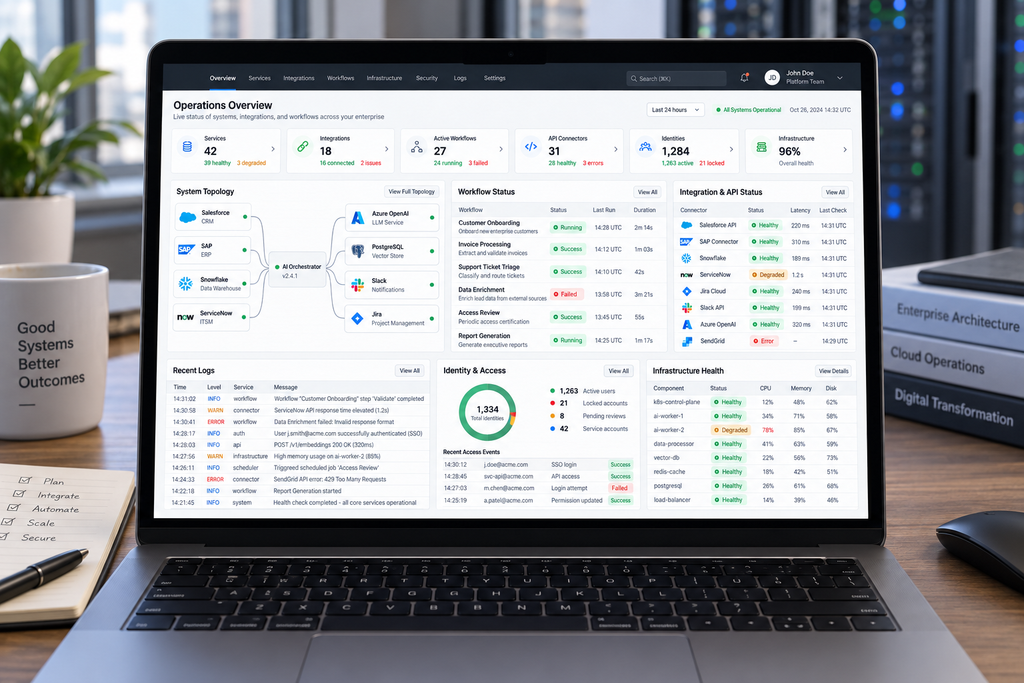
Pilot conditions vs production conditions
| Dimension | Pilot | Production |
| Data | Curated sample | Live, messy, permissioned |
| Identity | Shared test account | Per-user, least privilege |
| Failure | Try again | Incident, rollback, audit trail |
| Cost model | Unmetered experiment | Cost per task, budgeted |
| Improvement | Manual prompt edits | Feedback loop into retrieval |
| Approval | One sponsor | Security, legal, compliance |
| Success measure | It looked impressive | Baselined, measured, defensible |
What we’ve learned building the layer underneath
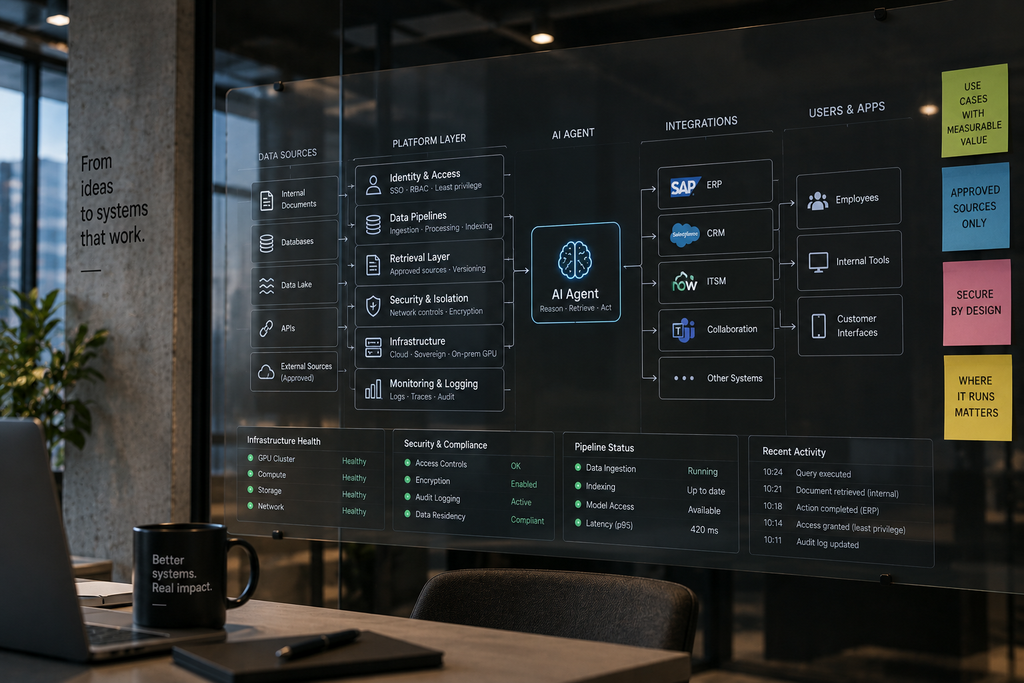
Most of our AI work isn’t the agent. It’s the platform that lets an agent survive contact with an enterprise: identity, network isolation, data pipelines, GPU capacity, logging, and the security posture wrapped around all of it.
Three habits separate the deployments that reach production from the ones that get a nice slide at year end.
Pick a task with a number attached. Not “improve productivity”, but something with a current cost, a current duration and a current error rate, baselined before anything gets built. Without a before there is no after, and no defence when finance asks what changed.
Ground it, then constrain it. Retrieval against approved sources keeps answers inside material the organisation will actually stand behind. Add least-privilege access and full logging and “what might it say?” becomes a question with a bounded answer.
Decide where it runs before you build it. Managed cloud, sovereign cloud or your own GPU cluster isn’t a late hosting detail. It sets cost, latency and whether the deployment is legal for the data involved, which in this region is often the binding constraint rather than a preference.
The honest read on those forecasts
You could read “95% fail” and “40% cancelled” as proof the whole thing is hype. To be fair, plenty of people have. But the same Gartner forecast expects 15% of day-to-day work decisions to be made autonomously by 2028, up from zero in 2024, and a third of enterprise software to include agentic AI, up from under 1%.
Both things are true at once. The technology is going to matter, and most of today’s projects won’t be around to see it. The difference is almost never the model. It’s whether anyone built the plumbing.
If you’re deciding where an agent should run and under whose rules, talk to 10ⁿ Tech about an AI automation audit.
Frequently asked questions
Why do most enterprise AI pilots fail?
MIT’s NANDA research found around 95% of generative AI pilots fail to deliver measurable value, because most tools cannot retain feedback, adapt to context or improve over time. The blocker is usually memory, integration and governance rather than model quality.
What is agent washing?
Gartner’s term for rebranding existing products – AI assistants, RPA and chatbots – as agentic AI without substantial agentic capability. Gartner estimates only about 130 of the thousands of agentic AI vendors are genuine, so vendor due diligence matters more than usual.
How do you prove ROI on an AI agent?
Baseline a specific task before building: current cost, duration and error rate. Measure the same things afterwards. Without a documented before there is no defensible after, and “escalating costs, unclear business value” is the most common reason projects get cancelled.
Should AI agents run in the cloud or on-premises?
It depends on the data. Managed cloud is fastest to start; sovereign cloud or an on-premises GPU cluster may be required where data residency rules apply. Decide before building, because it determines cost, latency and legality, not just hosting.
What makes an agent production-ready?
Grounding against approved sources, least-privilege identity, integration with systems of record, complete logging of every action, a feedback loop that improves retrieval, and a cost per task you can budget against.
