Summary: Every data vendor a commodity trading desk already pays for now ships its own AI chat. What nobody sells is one assistant across the CTRM, the mailboxes, the contracts, the licensed feeds and the sanctions lists, inside the desk’s own tenant. We built that as a prototype with TMICC, a trader tested it for two hours, and it passed 7 of his 13 scenarios. This is what we learned.
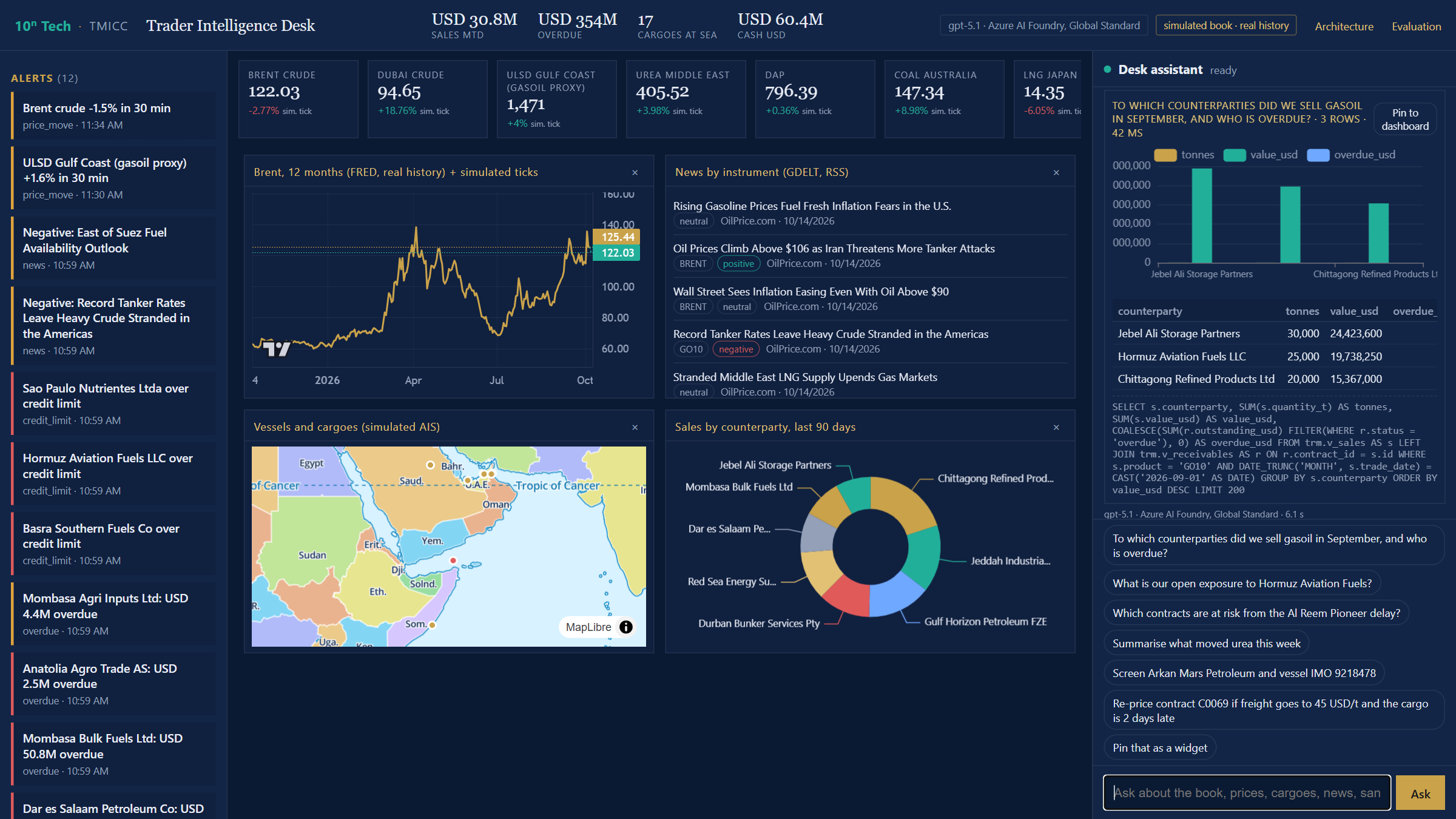
“To which counterparties did we sell gasoil in September, and who is overdue?”
A trader cannot ask that question today in one place. The sales sit in the CTRM. The overdue invoices sit in the ERP. The context sits in a dozen email threads. Someone pulls three exports into Excel, and the answer arrives tomorrow.
That one question is the whole case for AI on a commodity trading desk.
The chat over market data is already free
We started by listing what desks already pay for. Kpler ships a copilot and MCP connectors. Bloomberg has ASKB. S&P Global works through Microsoft 365 Copilot. LSEG offers MCP. Windward and Sparta sell their own AI layers. CTRM vendors are adding natural-language queries inside their products, SAP Joule among them.
So “ask questions about market data” is already included in subscriptions the desk pays for. It is not a product a buyer needs from anyone else, and a demo built around a price chart with a chat box loses the room.
AI for commodity trading starts with the join
What nobody we found sells, as of mid-October 2026, is the join: one assistant that reads the CTRM extract, the mailboxes, the contracts, the licensed feeds and the sanctions lists together, raises alerts, and runs inside the customer’s own tenant without picking a data vendor.
That is where the money questions live. Which insurance reserves can we release now that title has transferred? If this vessel is two days late and freight goes to 45 dollars a tonne, what happens to the price on that contract? Which counterparties are over their credit limit after today’s deliveries?
Each of those needs three systems at once. None of them is answered by a chat window on top of one data feed.
How the prototype works
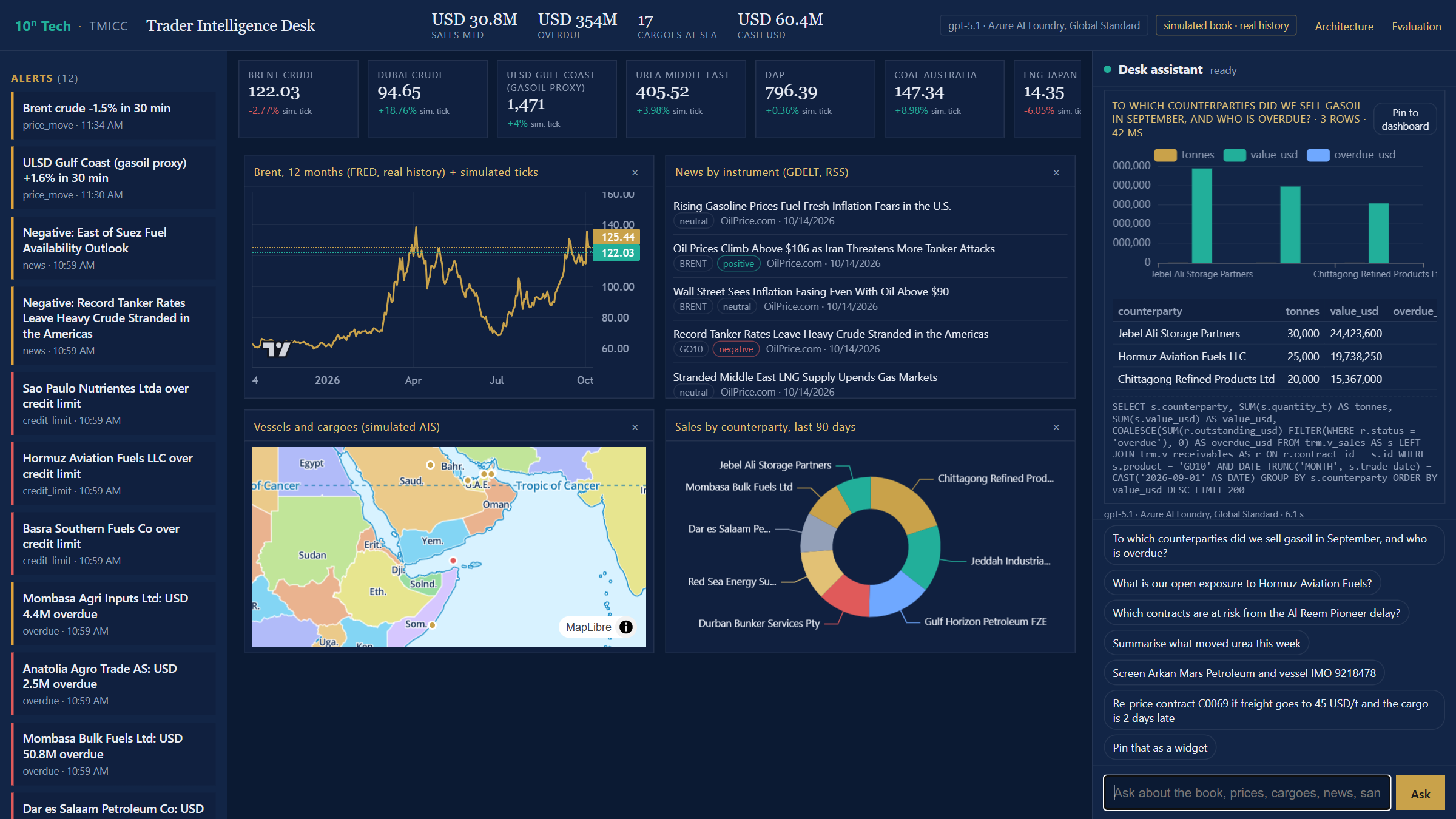
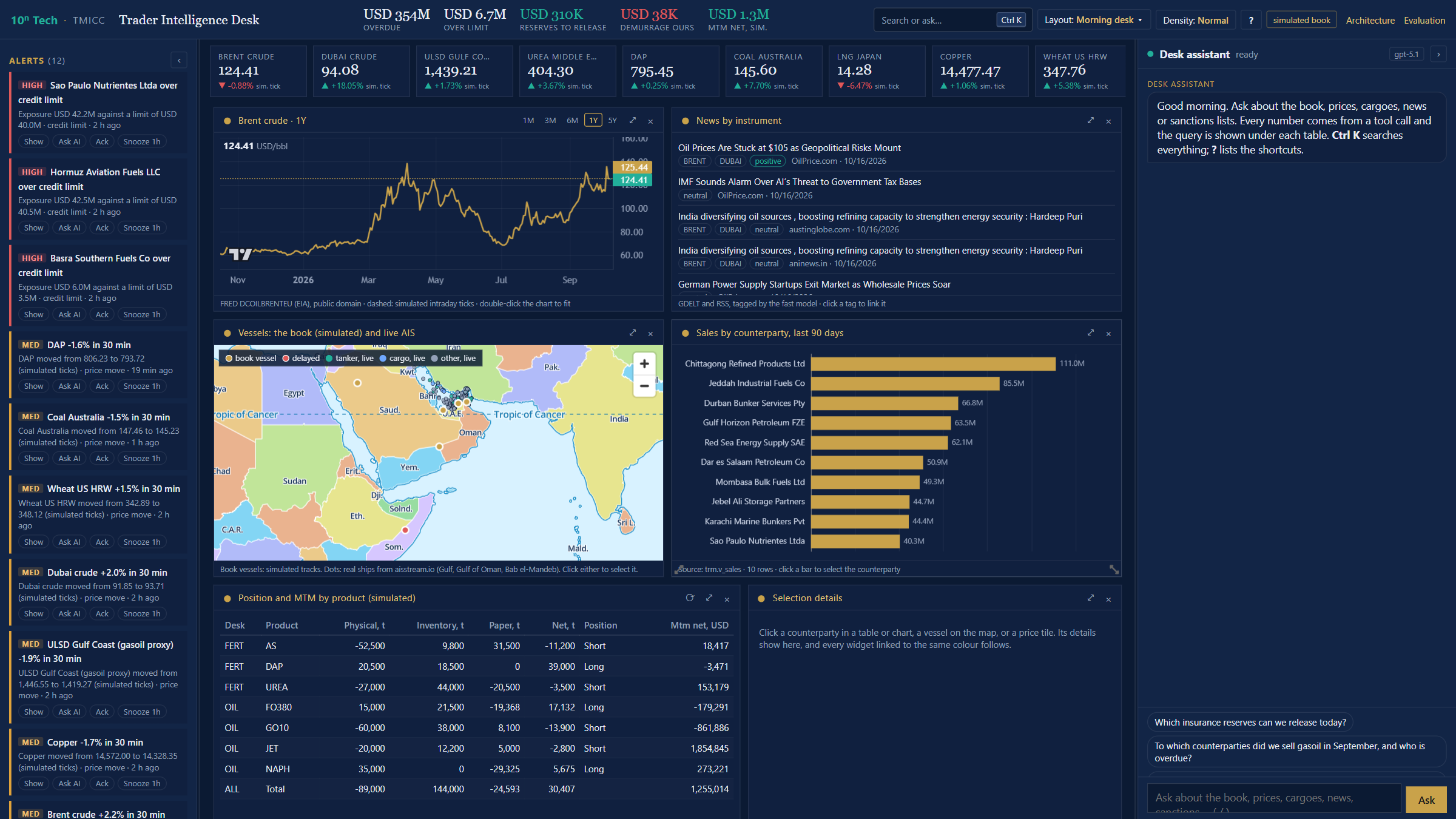
We built the Trader Intelligence Desk with TMICC on a simulated book: invented counterparties and cargoes, real price history from FRED, live news from GDELT, and live ship positions from AIS in the Gulf, the Gulf of Oman and Bab el-Mandeb, kept apart from the simulated vessel tracks.
Underneath is one agent with eight tools. The part that decides whether it works is how it queries data. Text-to-SQL over a raw ERP schema scores around 10% on enterprise benchmarks: the model cannot guess what a column called STATUS_3 means. So the assistant queries twelve views with business names, a sales view and a receivables view rather than raw tables, and it learns from twenty verified example questions. Every SQL statement is checked before it runs, and every answer shows the query under the table, so a trader can see where the number came from.
On our own test set of twenty questions it answered twenty correctly, with a median response of 6.1 seconds.
What the trader’s test found
Our own test set is not a trader. On 16 October a trader who has run physical oil desks spent two hours on it with his own scenarios. Seven of thirteen passed.
The six that failed were telling. He wanted a paper book next to the physical one, mark-to-market by product, and re-pricing that follows the Incoterm of each contract, so a CFR sale and an FOB sale move differently when freight changes. All three are gaps in the trading data model, and the second round adds them.
That is the lesson we keep relearning: the engine is a commodity. The work is the data model, the joins and the measurement on the desk’s own data.
How a desk should start
- Pick the three cross-system questions the desk asks every week and cannot answer in one place.
- Take one extract from the CTRM and one from the receivables ledger, not the whole estate.
- Build fifteen views or fewer with business names, plus verified example questions for each.
- Measure: questions answered correctly, time to answer, and how many spreadsheet pulls it replaced.
We run this as a fixed-price pilot on the desk’s own extract. The broader method is in why enterprise AI agents stall between pilot and production.
Frequently asked questions
Our data vendors already have AI. Why would a desk need more?
Each vendor’s AI answers questions about its own data. The questions that move money join several systems: sales, receivables, contracts, vessels and sanctions lists. That join is what a desk does not have today.
What data does an AI trading desk assistant need?
An extract from the CTRM, the receivables ledger, the contracts, and whatever feeds the desk already licenses. Mail and sanctions lists can be added later. Start with two sources and a few views, not the whole estate.
Can it run inside our own tenant?
Yes. The prototype runs on Azure, and a pilot runs in the customer’s own tenant with the customer’s own access rules.
Why not let the model query the ERP directly?
Text-to-SQL over raw enterprise schemas scores around 10% on public benchmarks. Business-named views with verified examples and a SQL check before every run are what make the answers dependable.
Next step
If your desk spends mornings joining exports in Excel, we can show you the prototype on a simulated book and scope a pilot on your own extract. See our enterprise AI work, or get in touch.
