Summary: Industrial land and warehouses sell on plot terms, not renders: setbacks, tenure, lease rate and distance to the port. These are the lessons from three plot explorers in Oman, Saudi Arabia and the UAE, including why massing must follow the setbacks and why warehouses lease by the unit.
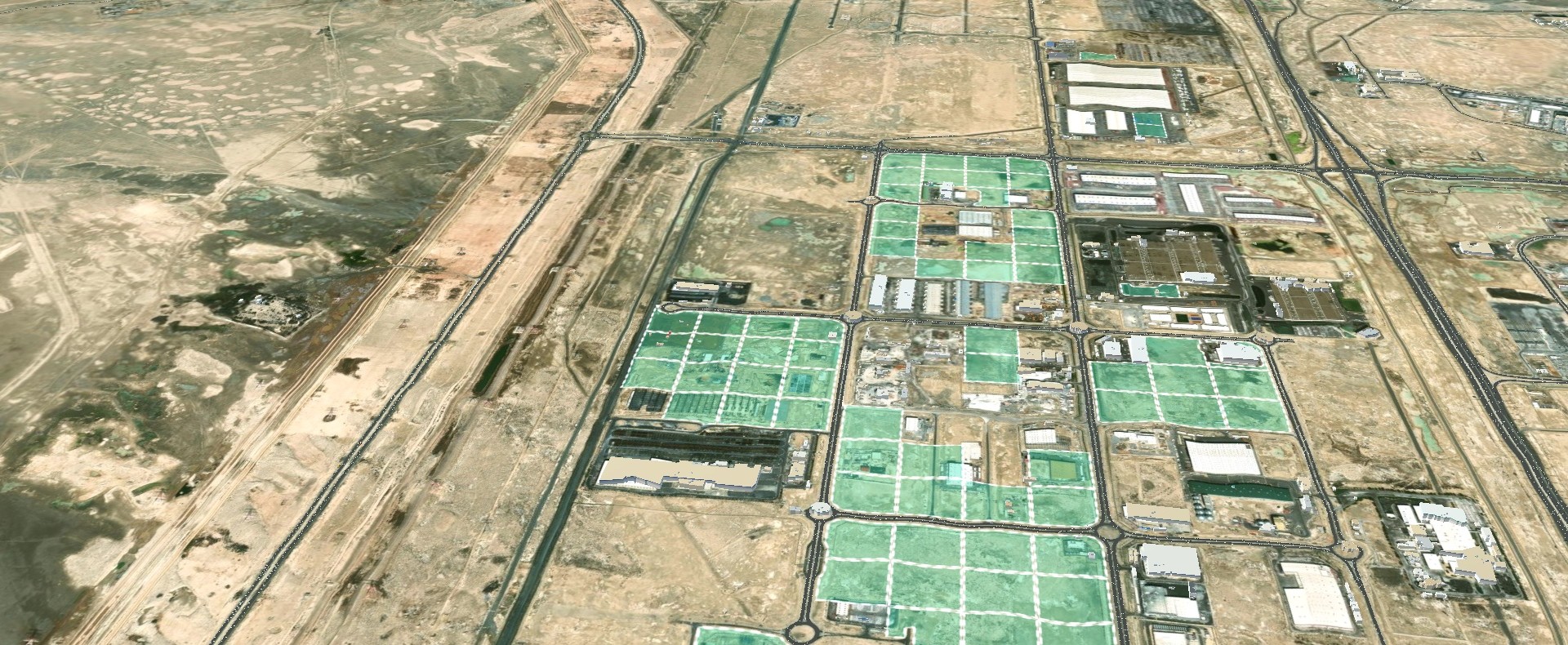
One free zone in Oman publishes 15,502 plots on its public map. 13,296 of them are vacant. Each one comes with its status, its setbacks and its lease rate, there for any investor who knows where to look.
That number changed how we think about selling industrial land. This year we built plot explorers for three very different sellers: that free zone, a private developer subdividing an industrial city of about 1.95 million square metres near Riyadh into 464 plots, and an industrial zone in the UAE that leases warehouse units as well as land. None of them looked like the residential projects we were used to, and most of what we knew from selling apartments did not apply.
Industrial land buyers ask different questions
An apartment buyer asks about the view, the finishes and the floor. An industrial investor asks about none of that. The questions the tools had to answer were about the plot and the terms.
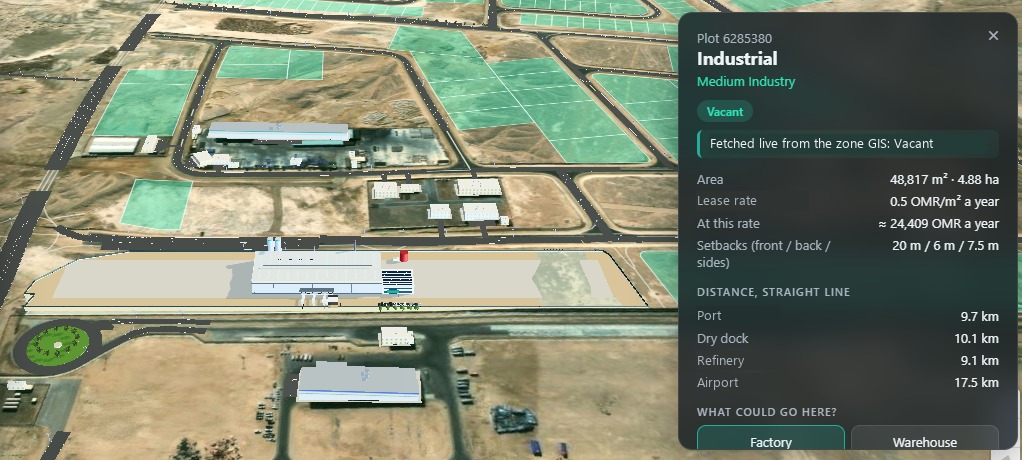
How far is it to the port, the dry dock, the airport? What can I build on it, and how close to the boundary? Is it for sale or only for lease, and at what rate? Which plots next to it are taken, and by whom? One investment team asked us flatly what the benefit was, for them and for the investor, and whether they could lose money on it.
Nobody asked about the render quality. One of them did ask whether the refinery in our model was real or boxes, which told us they were checking, and that a single fake-looking detail costs credibility well beyond its size.
It sells in stages and under several kinds of deal
The Riyadh developer laid out their plan in three stages. First, raw serviced plots, with a target of 40 to 60% of the city sold as land. Later, shell buildings in three types only: warehouse, light factory and ready factory. Finally, the developer builds out the rest itself and sells finished buildings.
A week later they added the part that reshaped the whole data model. A buyer can choose between three tenure models:
- Buy a serviced plot outright.
- Take a long lease of 15 to 20 years, with the developer building to the tenant’s requirements.
- A combination, where a third-party developer builds and resells while the landowner stays in as an investor.
A sales tool that shows a plot as simply “available” with one price cannot carry that. Each plot needs its stage, its land use, its tenure options and its terms, and the display has to change as the city moves from selling land to selling buildings. Sold plots must drop off the map on their own, straight from the CRM, or the sales team will spend its mornings apologising.
Warehouses for lease go by the unit
The UAE zone added a third shape of deal. Much of what it leases is not land at all but warehouse space in long sheds, and a tenant rents a unit, not a building.
So the sheds were split into leasable units on a 12.5-metre bay, each drawn in 3D with its dock doors and fire walls, and each roof coloured by status. Click a unit and its card shows the size, the doors, the power, the floor load, a market rent band from published broker figures, the distance to the port, and a link of its own that a leasing agent can send. The statuses in the demo are illustrative until the zone shares its unit list, and we say so on the screen.
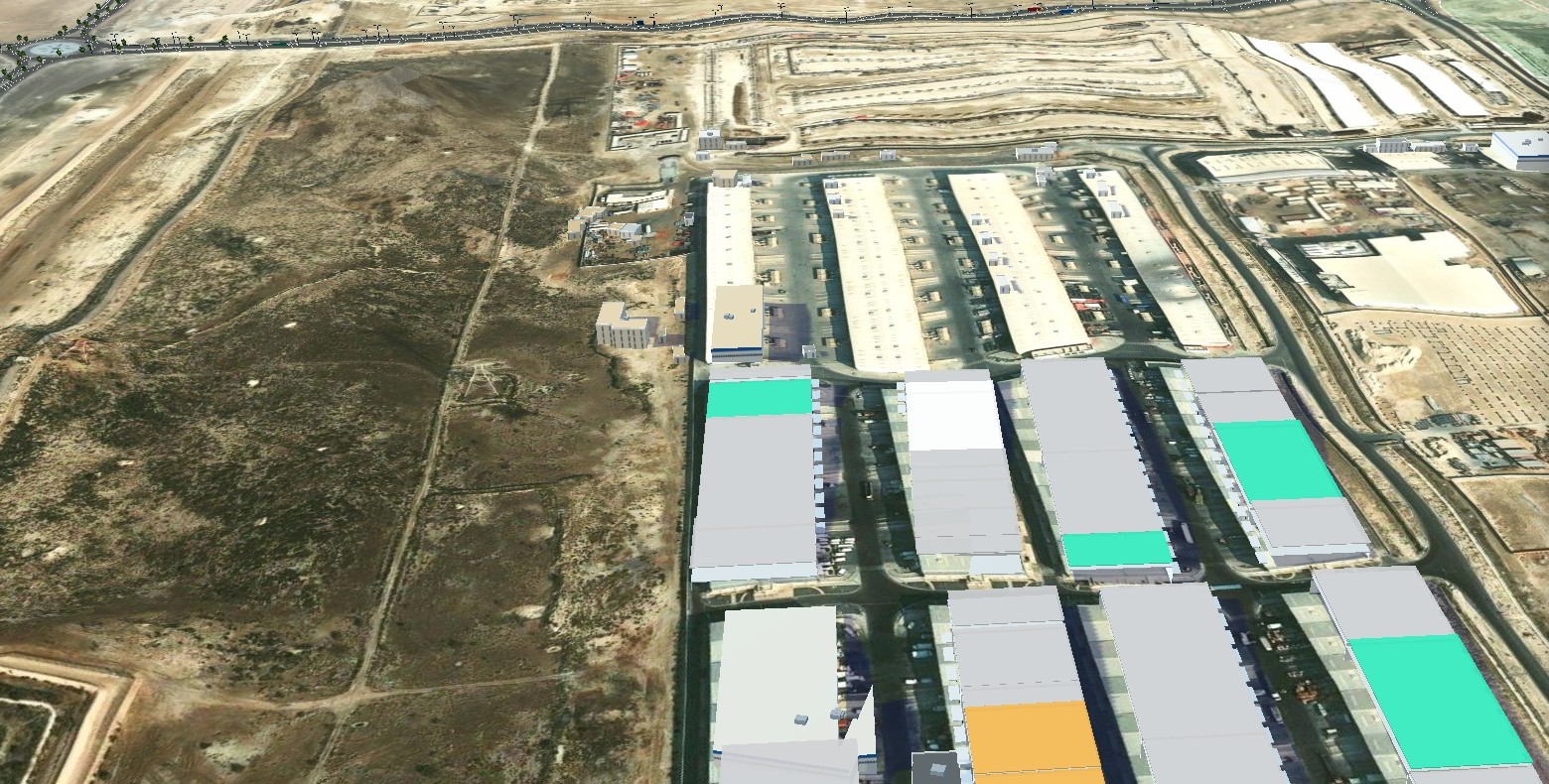
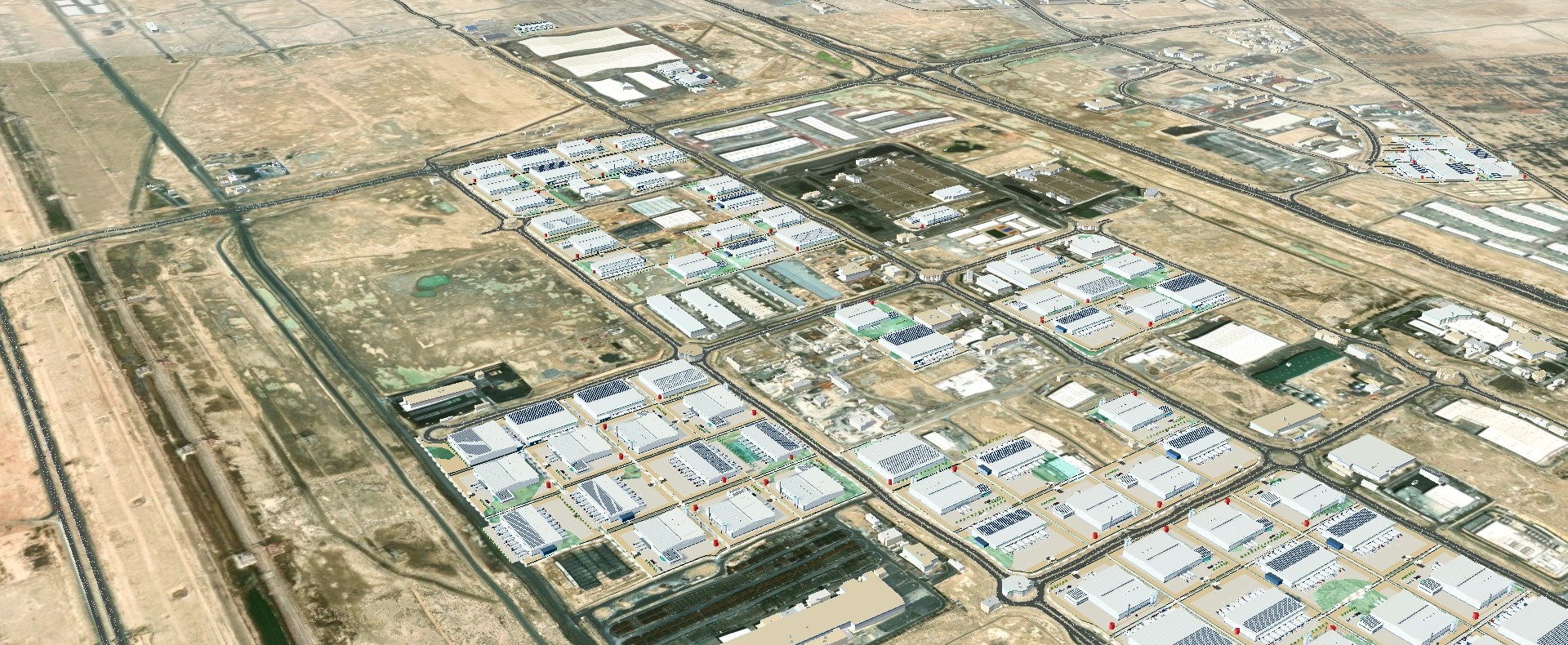
Land in the same zone was a separate story: 113 development plots on blocks that were still empty on the latest satellite photo, and a built-out view that shows the cluster finished, so it can be sold before it exists.
Massing has to obey the rules
For industrial land, the building you show on a plot is a promise about what can be built there. Get it wrong and the investor’s engineer dismisses the whole presentation.
In Saudi Arabia, MODON’s building requirements govern what a tenant may construct on an industrial plot, and they apply inside privately developed industrial cities too, not only in MODON’s own estates. Before we applied the statutory setbacks, our generated warehouses were oversized by about 49% and our ready factories by about 63%. A technical reviewer notices that immediately.
The fix is unglamorous. Inset each plot by its front, rear and side setbacks before placing any building. Where a parcel is too small to carry the full envelope, fall back to a simple coverage ratio. For mosques, shops and public buildings, setbacks are a design choice, so a plain coverage ratio is the honest answer there too.
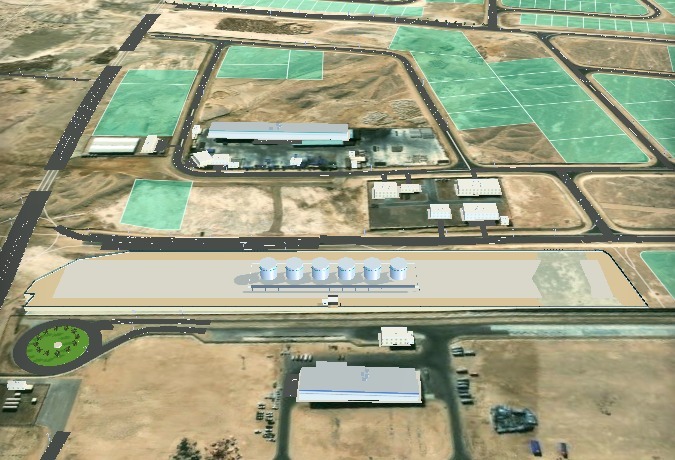
What we did not need was architecture. Generic volumes in the right size and the right place are correct for industrial land, and the Riyadh customer said so directly.
What to skip
The first two sellers already had a lot. The Riyadh developer had a professionally produced four-minute film and a library of renders. The free zone had its own drone tour, its plot data and its master plan, all public. A vendor quoting a new visual package to either of them would have been charging for pictures they already owned.
What neither had was the link between the picture and the plot. The feature that sells is short to describe: click a vacant plot, see its terms, drop a factory, a logistics hub or a tank farm onto it inside the setbacks, and see the distance to the port. The 3D city around it is supporting cast.
What it is worth
For an investment-promotion team the arithmetic is simple. Their deals run to many times the cost of the tool. If it helps close one or two extra deals a year, it has paid for itself, and that is the question to put to whoever is buying it.
What to check before you commission a plot explorer
- Ask whether plot status, terms and prices come from your own system or are typed in by hand. Typed-in data drifts from the real register.
- Ask how setbacks and building rules are applied to the massing, and which regulation they follow.
- Ask whether the tool can show more than one tenure option per plot, and change as you move from land to buildings.
- Ask what visual production you are paying for that you already own.
Frequently asked questions
What do industrial land buyers want to see?
The plot and its terms: size, land use, setbacks, tenure options, lease rate or price, and the distance to the port, airport and main roads. Render quality comes far behind.
Why do setbacks matter in an industrial plot explorer?
Because the building shown on a plot is a promise about what can be built. Without statutory setbacks our generated warehouses were about 49% too big and ready factories 63%.
Can one tool handle land sales, long leases and warehouse leasing?
Yes, if each plot or unit carries its stage, land use, tenure options and terms, and sold or leased items drop off the map from the CRM.
Does an industrial plot explorer need new 3D renders?
Usually not. Generic volumes in the right size and place are correct for industrial land, and most owners already have a film and renders.
Next step
If you sell or lease industrial land and want investors to pick a plot instead of a brochure page, send us your plot list. See who builds digital twins in Dubai, or Get in touch.
Photo by Adrian Sulyok on Unsplash
