Summary: Most VR training pilots do not fail on technology. They fail on the business case – the champion cannot justify the spend to management. This is how we scope a VR training pilot that proves ROI: the one task to pick, the pre-project survey to run, the metrics to fix up front, and the phasing that keeps risk small.
Almost every VR training pilot that stalls, stalls for the same reason: not the technology, the business case. The champion is convinced. Their management is not, because nobody agreed in advance what “success” would look like or how it would be measured.
We have scoped and delivered more than 20 industrial VR simulation projects. The ones that turn into rollouts all did the same unglamorous thing first: they treated the pilot as a business-case exercise, not a technology demo. Here is how to do that.
Step 1: pick one task – the right one
The instinct is to model the whole facility. Resist it. A pilot exists to prove value on the smallest scope that can carry a convincing result.
Pick a single task that fails the D.I.C.E test – where traditional training is Dangerous, Impossible, Counterproductive, or Expensive/rare:
- A high-risk manual procedure (an emergency shutdown, a confined-space entry).
- A task you cannot safely stage on the live asset.
- Training that would disrupt production or tie up your best people.
- A rare, high-consequence event nobody gets enough real practice on.
One task, one clear training gap, one measurable outcome. That is a pilot. Everything else is scope creep dressed up as ambition.
Step 2: run a proper pre-project survey
The pilot’s credibility is set before a single scene is built, in the survey. This is where you turn “we want VR training” into defensible functional and technical requirements. In our projects the input mix looks roughly like this:
- ~30% task cards, regulations, and operating procedures – the ground truth of how the job is actually done.
- ~20% an in-person survey of the process, with photos and video of the real equipment.
- ~20% existing training methodologies and materials – what already works, what does not.
- ~10% interviews with the people who will actually use it.
- ~10% occupational-safety regulations and approaches.
- ~10% IT infrastructure and how the simulator will integrate with corporate systems.
The output is not a mood board. It is an analytical report, a feasibility view, the functional and technical requirements, the specific training scenarios, and – critically – the KPIs. Skip this and you get an impressive demo that no auditor or CFO will trust.

Step 3: fix the metrics before you build
ROI is only provable if you decide, in advance, what you will measure. The metrics that consistently carry a business case are simple:
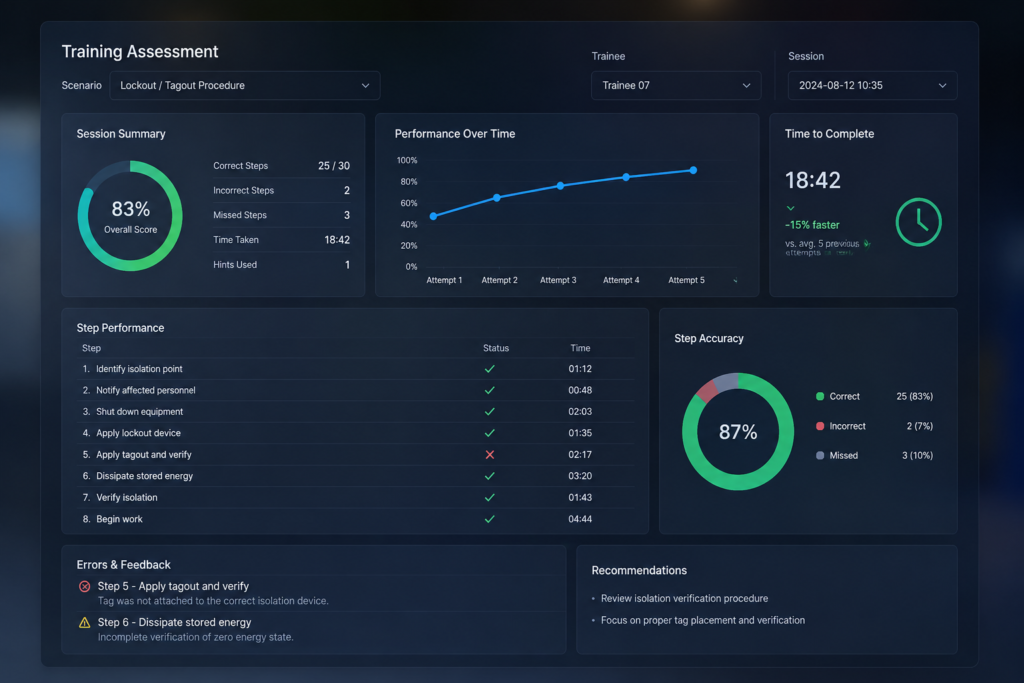
- Time to complete a scenario – how the learning pace improves over sessions.
- Task-fulfilment accuracy – the percentage of actions performed correctly.
- Trainees per month – how throughput changes once training no longer needs the live asset.
- Error and incident reduction – the safety outcome the whole thing exists for.
- Downtime avoided – training that no longer takes equipment offline.
- Onboarding time – how fast a new hire reaches competence.
Baseline these under the current method first. Without a “before”, there is no “after”, and no ROI story.
Step 4: phase it so risk stays small
A well-scoped pilot is staged, with a client sign-off at each gate rather than one big leap of faith. A typical shape:
- Scope and design – requirements, scorecard, scenario design, sign-off.
- Build – the simulator and its scenarios.
- UAT – the client tests against the agreed scorecard and accepts.
- Go-live – production release and first training cohort.
- Support and measure – collect results against the Step-3 metrics, then decide on scale.
Each gate is a decision point. Nobody is asked to bet the whole programme up front, which is exactly what makes the “yes” easier to get.
The ROI math is not subtle
Two numbers carry most business cases. First, the cost of the incidents you are trying to prevent: the ASM Consortium puts abnormal situations in one industry alone at billions a year, most traced to human error. A single avoided shutdown or safety event can outweigh an entire training programme. Second, training efficiency: PwC found VR learners train up to four times faster – which is fewer instructor hours, less equipment downtime, and faster onboarding, every cohort. Put a real cost against your current training day and the pilot usually pays for itself before it scales.
What a well-scoped pilot looks like
A Gulf electricity and water utility came to us to modernise how it trains high-voltage cable jointers – a precise, high-risk manual task where a mistake is dangerous and expensive, and live practice is limited. That is a textbook D.I.C.E case: one critical skill, a clear gap, a measurable outcome, and a natural path to scale (the same platform later extends to more procedures and integrates with the utility’s wider digital plans).
That is the shape to aim for. Not “let us build a digital twin of everything.” One high-risk task, scoped properly, measured honestly, and staged so the risk stays small – proven, then expanded.
For the operator-training version of this approach at municipal scale, see How digital twins improve industrial operator training. And when you are ready to scope your own, talk to 10ⁿ Tech about a focused VR training pilot.
Frequently asked questions
How big should a VR training pilot be?
As small as possible while still proving value – one high-risk task, one training gap, one measurable outcome. Modelling the whole facility is the most common way pilots overrun and lose their business case.
How do you prove ROI on VR training?
Baseline your current training first, then measure the same things after: scenario completion time, task accuracy, throughput, error/incident reduction, downtime avoided, and onboarding time. Set these metrics before building, or there is nothing to compare against.
What does a VR training pilot actually cost to justify?
The two levers are avoided incidents (often worth more than the whole programme) and training efficiency – PwC found VR up to four times faster, which cuts instructor hours, downtime, and onboarding time each cohort. Put a real number on your current training day and the comparison is usually clear.
How long does a VR training pilot take?
It is phased – scope and design, build, user-acceptance testing, go-live, then measurement – with a client sign-off at each gate. Staging it this way keeps the risk (and the decision) small at every step.
Which task should we choose for the pilot?
Use the D.I.C.E test: the training that is Dangerous, Impossible, Counterproductive, or Expensive/rare to run conventionally. That is where VR delivers the clearest, most defensible result.
