Summary: The test of any training is not what people remember in the room. It is what they do on the job, under pressure. This is what actually transfers from VR training compared with the classroom – the evidence, an honest side-by-side, and where each approach still earns its place.
Here is an uncomfortable fact about most corporate training: an employee can attend the session, pass the test, sign the sheet, and still freeze the first time it matters.
That gap, between knowing a procedure and performing it under pressure, is what training is supposed to close. It’s also what the classroom struggles with most. So the honest question isn’t whether VR beats the classroom. It’s what actually transfers to the job.
We’ve built more than 20 industrial VR training programmes, alongside plenty of ordinary courseware. Here’s what we’ve learned about the difference.
Knowledge is not competence
The classroom is good at one thing: transferring knowledge. It explains what should happen, in what order, and why. For understanding a concept, it is efficient and cheap.
But knowledge is not competence. Competence is the ability to do the right thing, in the right sequence, when the alarm is going off and the pressure is real. That is built by doing, repeatedly, with consequences – which is exactly what a lecture, a video, or an e-learning module cannot provide. The learner stays a spectator.
In high-risk work this is not a soft distinction. The ASM Consortium puts the cost of abnormal situations in the US petrochemical industry alone at billions a year, and around 40% trace back to human error. When the gap between knowing and doing has consequences that large, “they attended the course” is not good enough.
What the evidence says
The most cited independent study is PwC’s research into VR training effectiveness. Comparing VR against classroom and e-learning, it found VR learners were:
- Up to 275% more confident to act on what they had learned.
- Up to four times faster to train than in the classroom.
- 3.75 times more emotionally connected to the content than classroom learners.
- Up to four times more focused than their e-learning peers.
The confidence and emotion numbers are the ones that matter for transfer. People remember what they felt, not what they were told. Large enterprises running VR at scale have reported similar gains in retention across their programmes. The mechanism is well understood in the research as presence – when an environment feels real enough, the brain responds as if it is real, so the learning attaches to the situation rather than to a slide.
VR vs classroom vs e-learning: an honest comparison
No single method wins on every axis. This is roughly how they compare for skill-based, high-stakes training:
| Dimension | Classroom | E-learning | VR training |
| Transfers knowledge | Strong | Strong | Strong |
| Builds competence under pressure | Weak | Weak | Strong |
| Emotional engagement / confidence | Medium | Low | High |
| Measurable proof of competence | Subjective | Completion only | Objective (scored actions) |
| Training speed | Baseline | Faster | Up to 4x faster |
| Cost per learner at low volume | Low | Very low | Higher (build cost) |
| Best for | Theory and concepts | Broad, low-risk knowledge | Dangerous, rare, hands-on skills |
The pattern is clear: the classroom and e-learning are excellent for understanding; VR is where capability is built – and where you can actually prove it.
What we have learned makes VR transfer
Not all VR training transfers. The programmes that do share three habits.
Vary it. If the scenario runs identically every time, people memorise the film rather than learn the job, so we build in variable defects: noise, leaks, vibration, a valve that behaves differently today. The trainee has to read the situation instead of recalling a sequence. Without that, VR is just a nicer video.
Test at both ends. An entrance and exit assessment is what turns an experience into evidence, because task accuracy and response time before and after are the only proof that competence actually moved. That’s the part a supervisor, an auditor or a CFO will trust.
And keep it for the right jobs. VR earns its cost on the dangerous, the impossible and the rare: a fire response, an emergency shutdown, a confined-space entry. For low-risk theory the classroom is still the cheaper and better answer. Using VR everywhere is how programmes lose credibility, usually about eighteen months in.

The answer is usually “both”
The strongest training we have delivered is not VR instead of the classroom. It is a blend: the classroom and e-learning for the knowledge, VR for the competence that has to hold up on the worst day.
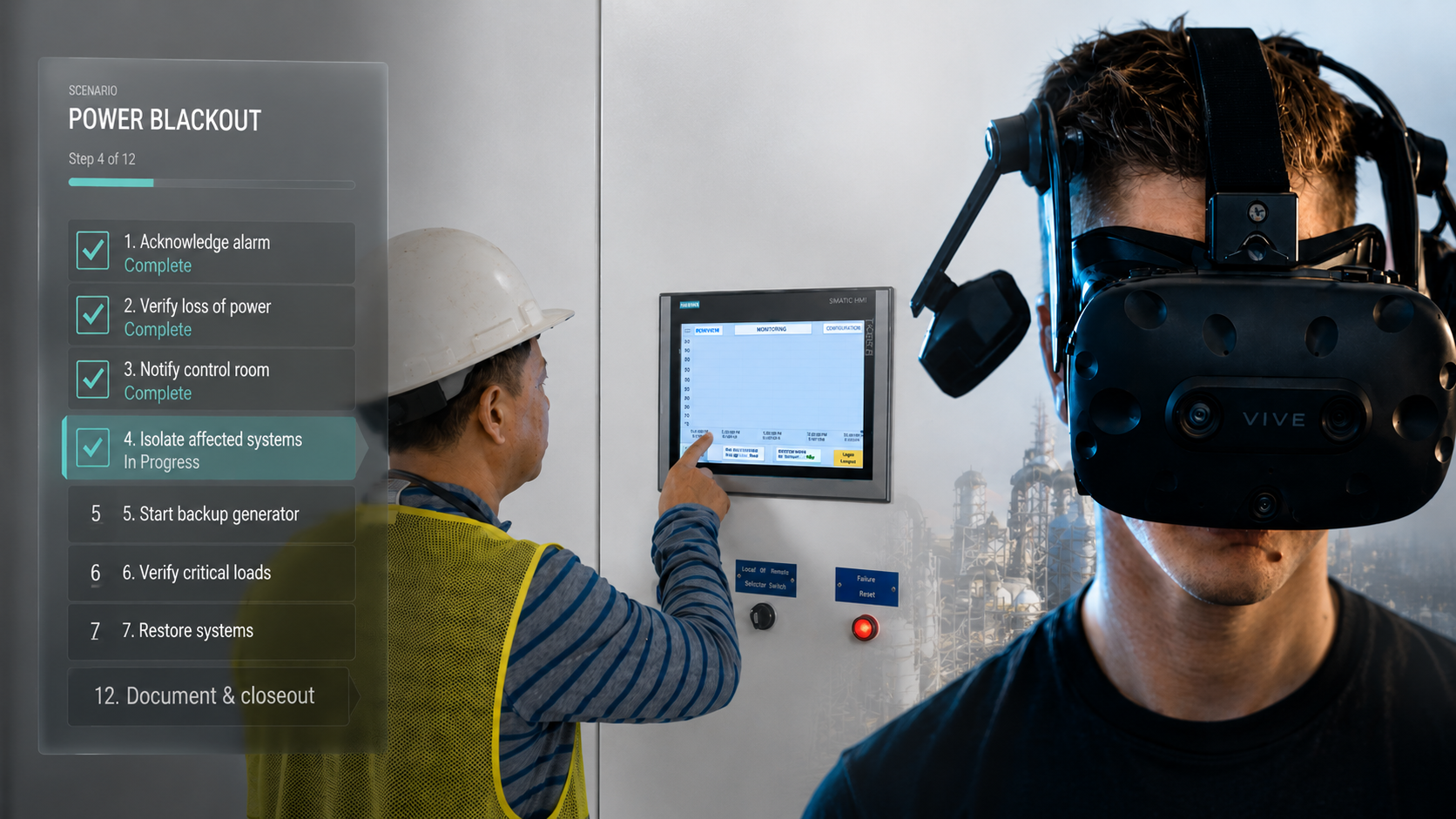
At Dubai Municipality, operators still learn theory conventionally – then rehearse fire, flood, and blackout in VR, on a replica of their own control system, until the response is automatic. The classroom told them what to do. The VR made sure they could do it. (More on that operator-training work in How digital twins improve industrial operator training.)
If you only remember one thing: judge training by what transfers to the job, not by what fills the room. On that test, for the skills that carry real risk, VR is hard to beat.
Frequently asked questions
Is VR training really more effective than classroom training?
For skill-based, high-stakes training, yes – because it builds competence, not just knowledge. PwC found VR learners up to 275% more confident to act and up to four times faster to train. For pure theory, the classroom is still efficient and cheaper.
Does VR training improve knowledge retention?
It improves the durability of skills because learning attaches to a felt experience rather than a slide – the “presence” effect. Enterprises running VR at scale report higher retention, and entrance/exit assessments let you measure the gain directly.
When should we still use the classroom or e-learning?
For concepts, background knowledge, and low-risk procedures where understanding is enough and the cost of a mistake is low. The classroom and e-learning are efficient there; VR adds cost without much benefit.
How do you prove VR training actually worked?
By scoring performance on the way in and on the way out – task accuracy, response time, missed steps – and tracking improvement across sessions. That turns a training experience into auditable evidence of competence.
Can VR replace hands-on training entirely?
No. It closes the gap between knowing a procedure and having performed it, so people reach real equipment better prepared. It works best as one layer in a blended programme, not a total replacement.
Related resources
- VR and AR solutions
- VR HSE and safety training simulators
- Industrial digital twin and operator training simulator
- How digital twins improve industrial operator training
Photo credits: XR Expo and CX Insight on Unsplash.
