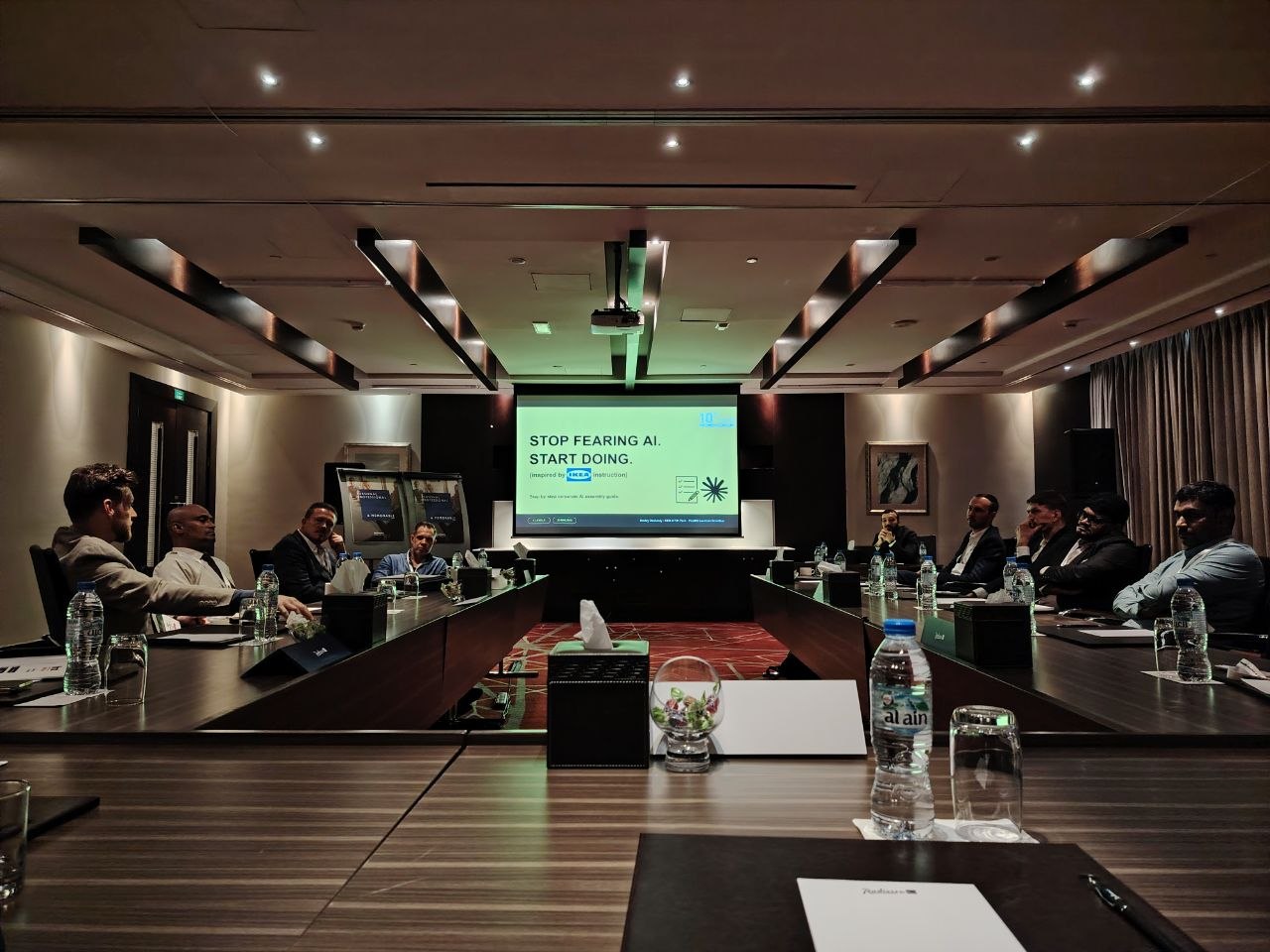
This week I spoke at a business breakfast in Dubai, to a room of construction and contracting executives. Good coffee, and the kind of audience that has heard “AI transformation” often enough to have developed antibodies.
That word is most of the problem. Transformation is what we call a thing when nobody knows the first step. It implies a program, a budget line, an outside consultant and a steering committee that meets every second Thursday until everyone quietly loses interest. Nobody transforms a wardrobe. You assemble it on a Saturday, from a diagram that assumes nothing about your expertise, using one allen key that is somehow the wrong size.
So I wrote the talk as assembly instructions instead.
The format is not mine. Ruben Hassid published a free guide called How to start with Claude, written as IKEA instructions. At the end of my slides I pointed the audience to his guides. What I added is everything that comes after one person gets good at this: the company, the security, the data platform, and the part where two hundred employees need access and your infosec lead has questions.
An independent format homage, by the way. Not affiliated with IKEA.
Before the first prompt
Five fears turn up in every one of these rooms. Our data will leak. It makes things up. The regulator will not like it. Our data is a mess. It will replace my people.
All five have answers. None of the answers is “wait and see.”
The number everyone quotes as a reason to wait
You have seen the statistic. Ninety-five percent of AI pilots fail.
That is not what the study found. MIT’s NANDA report, published in July 2025, found that 95% of organisations reported no measurable P&L impact from their AI pilots. The authors put that down mainly to companies having no baseline and no way to evaluate results, rather than to the technology underdelivering. They described their own figures as directionally accurate, and the headline number has been challenged since, largely for how narrowly it defined success.
Read properly, it is a measurement failure, not a technology failure. Most companies never set up a way to tell whether anything worked.
Which is worth putting next to Thomas Watson Jr., who ran IBM from 1956 to 1971:
I never varied from the managerial rule that the worst possible thing we could do would be to lie dead in the water with any problem. Solve it, solve it quickly, solve it right or wrong. If you solved it wrong, it would come back and slap you in the face and then you could solve it right. Lying dead in the water and doing nothing is a comfortable alternative because it is without immediate risk, but it is an absolutely fatal way to manage a business.
Solve it wrong and the slap is information. Never measure and no information ever arrives.
Parts list
Nothing here is exotic, and most of it you already own.
For you, one weekend
One executive sponsor, which is you. One strong-model seat on a business plan, not a personal one. One folder of text files that explains your company to it. One harness, which is the thing that turns a chat window into something that finishes work.
For the company, one quarter
Seats for everyone who touches company data. One gateway in front of them, armoured. Your ERP and the cloud tenant you already pay for. One infosec lead with a seat at the table from day one, which is what makes the regulator conversation boring. Boring is the goal.
Zero coding. Zero data scientists. Zero forty-page AI strategy documents.
The assembly sequence
AI adoption runs in four levels, and you cannot skip one. Level zero is you, one weekend. Level one is your team, one month. Level two is the organisation, one quarter. Level three is the regulated core, a year, in waves.
Level three built on level-zero habits is a demo. Level three built on a gate is a system.

Level zero: the weekend
Pick the strong model rather than the fast one. End your prompts with five words that change everything: “ask me questions first.” Give it goals, not tasks. Then create one project and load your context into it.
That last one sounds technical and isn’t. All the context everyone talks about is a folder of text files. Who you are, how you write, what you charge, what happened this week. If you can write a memo you can build context. Notepad works.
The harness
A chat answers and stops. A model with a harness finishes the job, because it can open your files, use tools, follow your rules, and check its own output before it comes back.
My favourite way to explain this is Memento. The man wakes up every morning with no memory, so he leaves himself notes, and the notes are what let him function. That is a language model at nine in the morning. Fully capable, remembers nothing about you. The files are the notes.
The model is the engine, the harness is the car, and you drive. The good part, the part I did not expect: you can build the car while driving it. This deck took months of evenings and it built most of itself.

Level two: the gate
Somewhere around level two you discover your staff did not wait for permission. They already paste company text into personal accounts, on their phones if the office network blocks it. Personal accounts on most vendors train on that data by default. There is a toggle, and I would not bet the company on how many people found it.
So one gate goes in front of everything. One login, one policy, every model behind it. Personal data stripped before a prompt leaves the building, token budgets per team, every call logged. Your CFO gets one bill instead of forty personal subscriptions surfacing on expense reports.
Business plans do not train on your data. That alone is a reason to make the company account the easy option. And the review of what you are exposing is a cybersecurity healthcheck conversation rather than an AI one.
Level three: data before agents
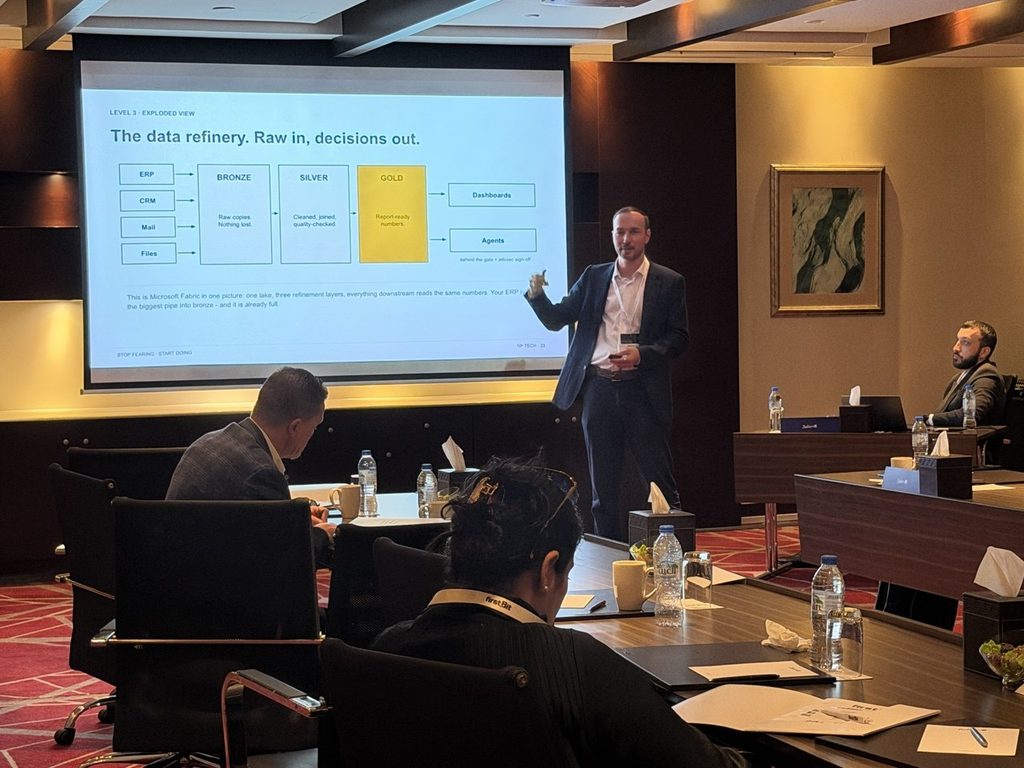
The pattern that works in regulated industries is dull and it is the whole trick. Do not start with AI, start with data.
One regulated financial group brought us twenty-five use cases and no data platform. We sorted them into waves. Dashboards on clean data first, no machine learning at all. Then regulatory reporting. Then predictions. Agents last, on purpose, behind the gate.
Someone asks about local models in every one of these rooms. It is possible, and we run it for government clients, but the trade-offs are real: smaller models, less context, and reports you wait fifteen minutes for. If your data genuinely cannot leave the country, that is a self-hosted enterprise AI question and the shape of the build changes.
If you run construction, the good news is that the raw layer already exists and you are sitting on it. BOQs, payment certificates, timesheets, actuals. Your ERP is the data platform you think you do not have.
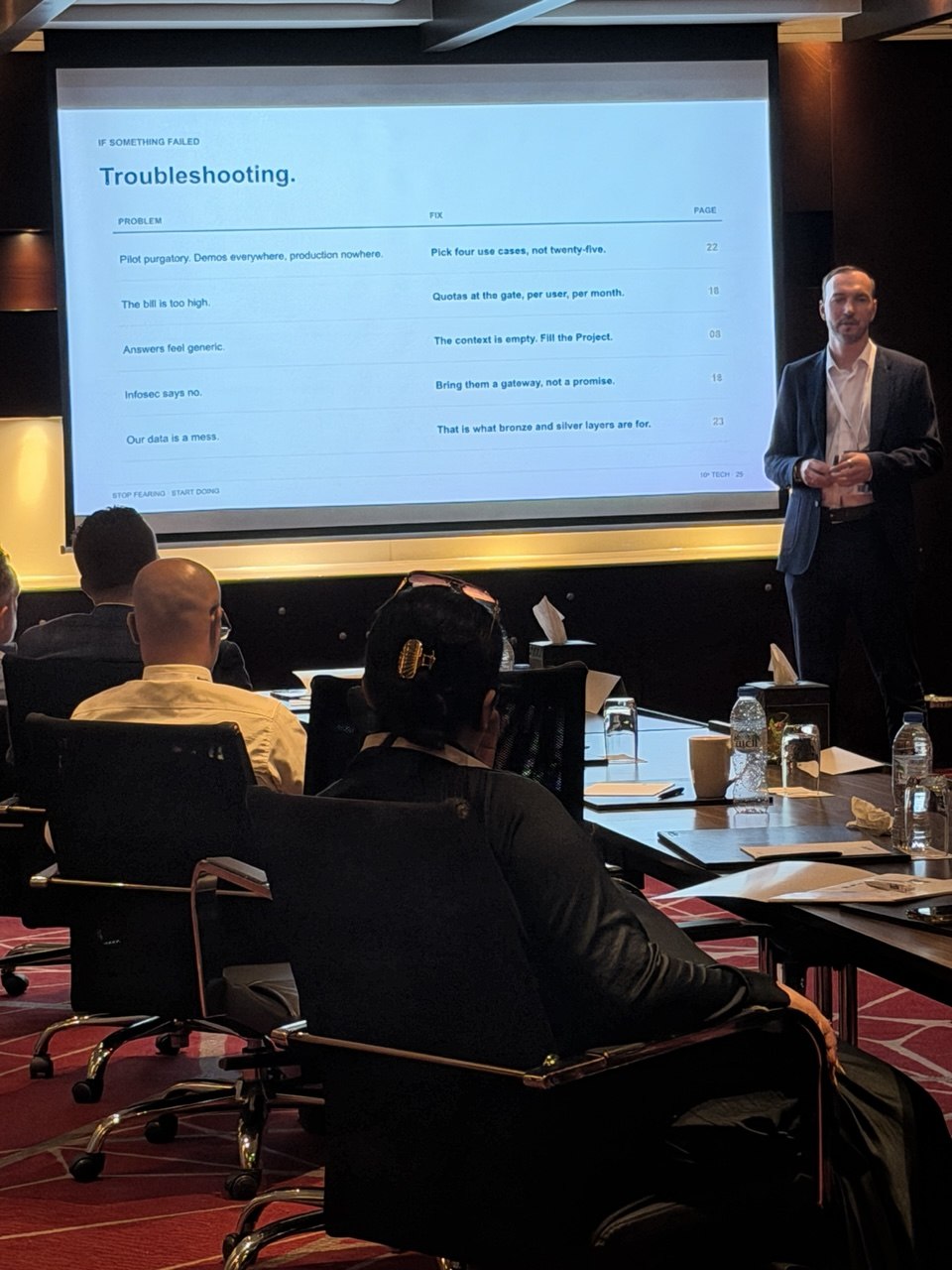
Troubleshooting
| Problem | Fix |
|---|---|
| Pilot purgatory. Demos everywhere, production nowhere | Pick four use cases, not twenty-five |
| The bill is too high | Quotas at the gate, per user, per month |
| Answers feel generic | The context is empty. Fill the project |
| Infosec says no | Bring them a gateway, not a promise |
| Our data is a mess | That is what the bronze and silver layers are for |
Why I think this is worth your weekend
For a long time I paid for a contractor arrangement that never quite delivered. Automation work around our CRM, permanently almost-finished. It ended around the time I started using Claude Code properly, and inside two months I had built everything I had ever asked for, plus a fair amount nobody had thought to ask for.
Our whole team plan costs a few hundred dollars a month, and rather less than that arrangement did. I am not going to pretend the maths is difficult.
One more piece of evidence, since executives reasonably ask where the enterprise money is actually going. Anthropic now leads enterprise LLM API market share, 40% against OpenAI’s 27%, and 54% against 21% in enterprise coding specifically, according to Menlo Ventures’ December 2025 research. OpenAI is far bigger in consumer subscriptions. The business-process work is going elsewhere, and that tells you something about where the value is being found.
This is too important to delegate. You cannot appoint someone to be transformed on your behalf.
