
Summary: Sovereign AI gets discussed in gigawatts. The question an architect actually faces is narrower: which of our data is legally required to stay in-country, and what does that force us to build? Here is the practical answer, including what the hardware really costs and how long it takes to arrive.
The headline version of sovereign AI is enormous. G42 confirmed in October 2025 that Stargate UAE is a 1GW cluster in Abu Dhabi, built with OpenAI, Oracle, NVIDIA, Cisco and SoftBank, with delivery from 2026.
Good news, and largely irrelevant to the question most architects are being asked this quarter. Which is simply: can this workload legally run where we want to put it?
For a lot of GCC data, that’s already written down.
Sovereignty is a legal requirement before it’s an architecture
The UAE’s general regime is Federal Decree-Law No. 45 of 2021, which sets the conditions for moving personal data across borders. Free zones layer their own rules on top, and DIFC runs under Data Protection Law No. 5 of 2020.
But the sharpest rule is sector-specific. Federal Law No. 2 of 2019 on ICT in health fields, Article 13, says this:
“It is not permissible to store, process, generate or transform the health data and information outside State – which are related to the health services provided inside State – except in the case where a resolution is issued from the Health Authority in coordination with the Ministry.”
Now read that against a typical AI proposal. “Store” is obvious enough. The word that catches people is “process”, because inference is processing. Sending a patient record to a model endpoint hosted in Ireland isn’t a grey area under Article 13. Neither is training on it.
That’s why these conversations start in healthcare, government and defence, then spread outward. Once one workload is pinned in-country, everything around it inherits the constraint.

“Sovereign” means at least four different things
Vendors rarely say which one they’re selling. Data residency means the bytes sit in-country, which is the weakest guarantee and the one most often quoted. Operational sovereignty is about who can reach the system and from which jurisdiction, and residency counts for very little if a support desk three time zones away holds the keys.
Legal sovereignty asks whose courts and disclosure regimes reach the operator regardless of where the disks spin. Technical sovereignty is the awkward one: if the vendor relationship ended tomorrow, could you still run this? That means model weights, not hosting.
Most tenders ask for the first and quietly assume the other three. That assumption is where projects get stopped late, after the architecture is already signed off.
Three deployment models, honestly compared
| Dimension | Managed cloud AI (in-region) | Sovereign / private cloud | On-prem GPU cluster |
| Time to first workload | Days | Weeks | Months |
| Data residency | In-region, operator-run | In-country, controlled | Fully in your estate |
| Operational sovereignty | Depends on support model | Strong | Complete |
| Model weights | Vendor-controlled | Yours or hosted | Yours |
| Capex vs opex | Opex only | Mixed | Capex-heavy |
| Cost at sustained load | Highest | Middle | Lowest per token |
| Who fixes it at 3am | The provider | Shared | You, or your MSP |
| Best for | Experiments, bursty use | Regulated data at moderate scale | Restricted data, steady heavy load |
What we see most often isn’t a single choice. It’s a split: general workloads on managed cloud, the regulated subset pinned to sovereign or on-premises capacity. Usually cheaper than forcing everything into the strictest tier, and easier to defend in an audit.
Buying the accelerators is not the easy part
There’s a comfortable story in which GPUs are a line item and the real work is elsewhere. That story is wrong, and it wrecks project plans.
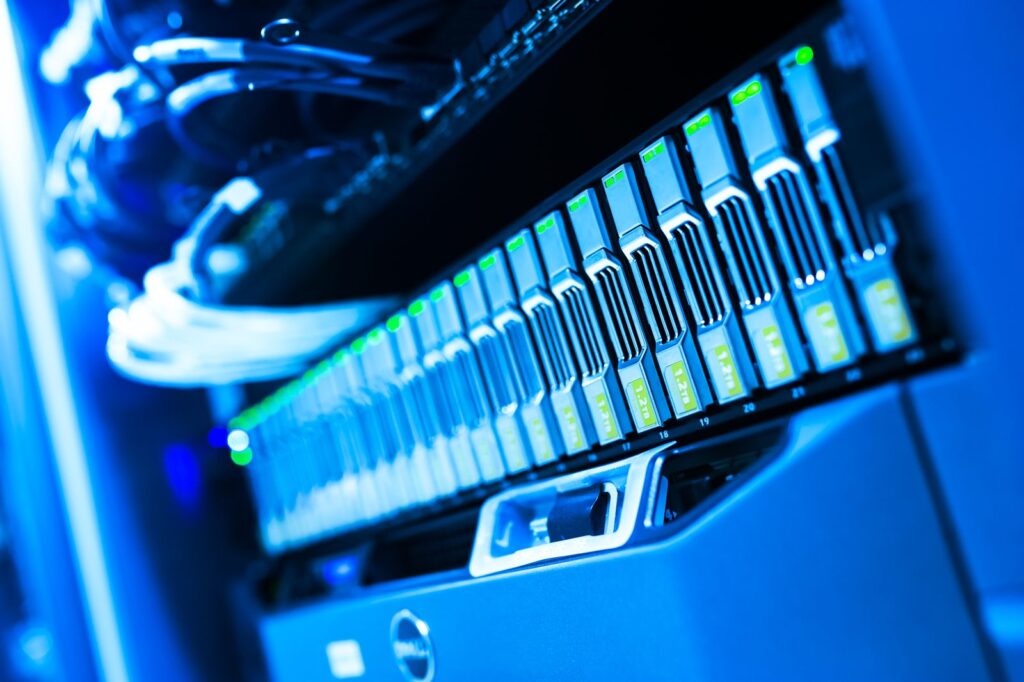
A single 8-GPU B200 or B300 server lands somewhere around USD 600,000 to 700,000 depending on configuration and who you buy through. That’s one node. Lead times have been running at roughly six months, sometimes longer, which means the hardware decision sits on the critical path from the day the project charter is signed rather than at the end of it. We’ve had BOMs where the delivery date, not the design, set the go-live.
Two consequences follow. Budget approval has to clear a capital number most IT committees don’t see in a normal year. And your architecture has to be fixed early, because you can’t reorder in month four when someone changes their mind about the model size.
The regulatory side has just moved in the UAE’s favour, though. On 10 July 2026 the US Bureau of Industry and Security removed the UAE from Country Groups D:3 and D:4 and reclassified it as Country Group A:5, the most favourable tier. Under the US-UAE AI Cooperation framework signed in May 2025, Commerce also approved the UAE Government and certain companies to receive advanced computing items licence-free, “including AI chips and servers”.
That matters commercially. It removes a licensing step that used to add months of uncertainty, and it puts the UAE in a small group of countries where this hardware can be bought without a case-by-case approval. It does not make the servers cheaper, and it does not make the queue shorter. Supply is still supply.
What else gets underestimated
Power and cooling come first. Dense AI racks change power draw per rack, cooling strategy and floor loading, and plenty of colocation contracts written for ordinary enterprise workloads simply cannot take them without a renegotiation nobody budgeted for.
Then the fabric between the nodes. At multi-node scale the east-west network decides whether the cluster performs anywhere near its spec sheet, and under-specifying it is the quietest way to waste the largest capital line in the whole project.
Day-2 is the one people skip. A sovereign platform is only sovereign if somebody in-country can patch it, monitor it, restore it and prove they did. Sovereignty without an operating model is a compliance statement waiting to fail its first audit.
And treat the inference endpoint as what it is: a data-access path. Private endpoints, no public model surface, least-privilege identity, an audit trail of every call. The same discipline you’d apply to any system holding the crown jewels, because that’s effectively what it now touches.
A sensible order of decisions
- Classify the data. Which categories carry a residency obligation, and which genuinely don’t.
- Name the sovereignty you need, in the requirement rather than the marketing.
- Size the steady-state load. Bursty work favours managed cloud; sustained inference favours owned capacity.
- Start the hardware conversation now, not after design sign-off, because six-month lead times make procurement a design constraint.
- Agree who patches, who restores and who evidences it for the auditor.
National-scale capacity is arriving either way. The organisations that get value from it will be the ones that already know which of their workloads can legally move, and which never could.
If you’re mapping that now, talk to 10ⁿ Tech about a sovereign AI platform.
Frequently asked questions
What does sovereign AI actually mean?
It covers four different guarantees: data residency (where the data sits), operational sovereignty (who can reach it and from where), legal sovereignty (whose courts reach the operator) and technical sovereignty (whether you could still run it without the vendor). Most tenders ask only for residency and assume the rest.
Does UAE law require AI data to stay in the country?
For health data, yes. Article 13 of Federal Law No. 2 of 2019 prohibits storing, processing, generating or transforming health data related to services provided inside the UAE outside the State, except by resolution of the Health Authority. Because inference is processing, that covers sending records to a model endpoint hosted abroad. Personal data more generally falls under Federal Decree-Law No. 45 of 2021.
What does a GPU server cost and how long does it take to arrive?
An 8-GPU B200 or B300 server runs roughly USD 600,000 to 700,000 depending on configuration, with lead times around six months. Both facts matter for planning: the capital number needs approval most IT committees are not used to, and procurement sits on the critical path rather than at the end of it.
Has it become easier to buy AI chips in the UAE?
Yes. On 10 July 2026 the US Bureau of Industry and Security reclassified the UAE into Country Group A:5, removing it from Groups D:3 and D:4, and approved the UAE Government and certain companies to receive advanced computing items licence-free, including AI chips and servers. That removes a licensing step, but it does not reduce price or lead time.
Can we mix sovereign and public cloud AI?
Yes, and it is usually the most economical answer: general workloads on managed cloud, with the regulated subset pinned to sovereign or on-premises capacity. Forcing everything into the strictest tier normally costs more than it needs to.
