Architecture
Agents decide what to do next. Tools decide what is allowed.
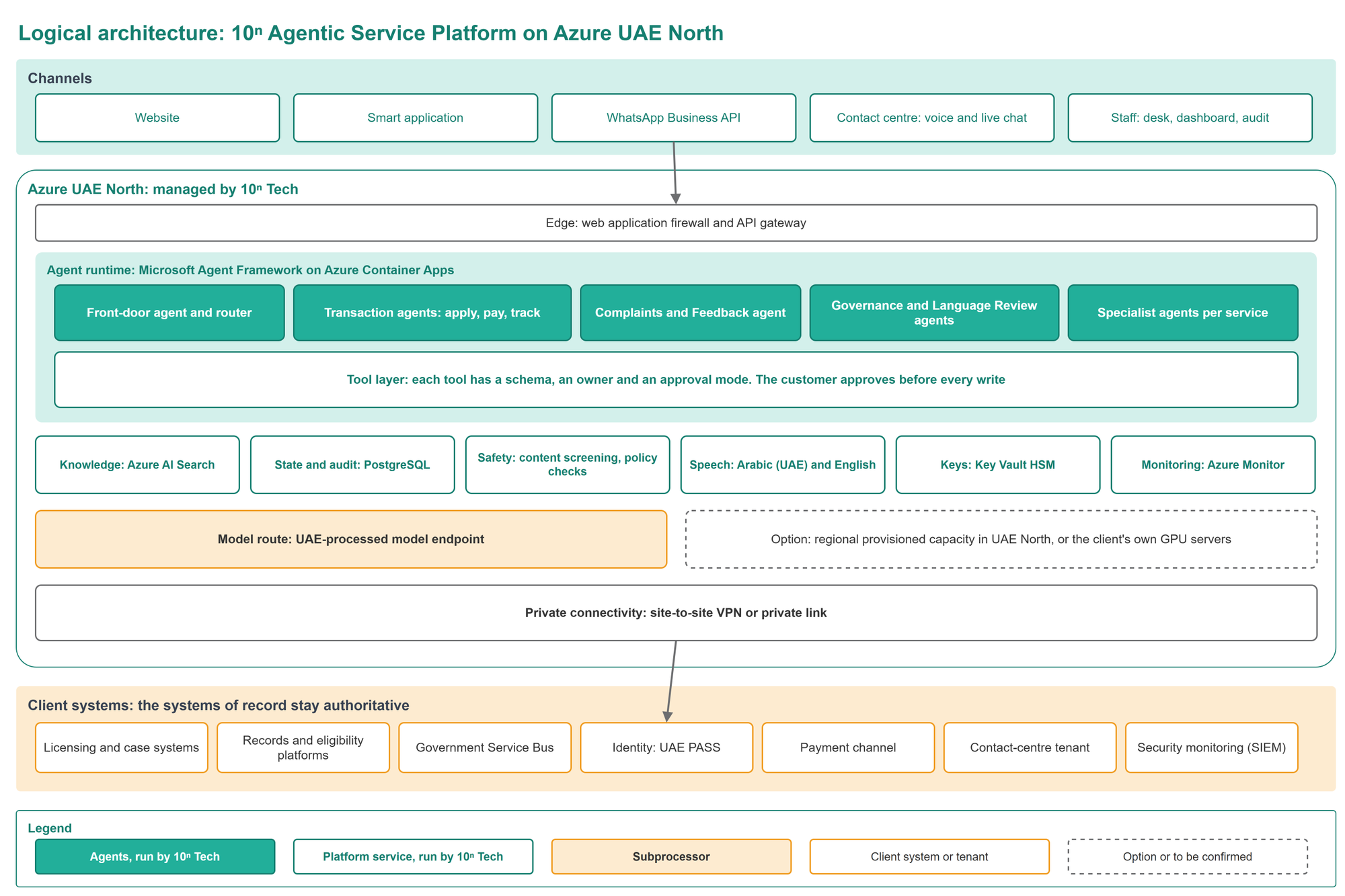
Summary: The 10ⁿ Agentic Service Platform is a multi-agent system written in code on Microsoft Agent Framework and deployed on Azure Container Apps in UAE North. Agents reason and route. Typed tools do the work and carry the rules. In production a gateway sits in front of the models, and search, PostgreSQL and telemetry hold knowledge, state and evidence. The client’s systems of record stay authoritative.
Multi-agent system: a front door and specialists
A front-door agent identifies the service and routes each message to a specialist: transactions, payments, status and certificates, complaints or governance. All of them share one session, so context survives every handoff. Routing runs on keyword rules by default, with a small model as an option; on a 14-turn test run, rules in place of a model call cut the median turn from 7.9 to 5.9 seconds. For case work, a coordinator calls specialist agents as tools: one checks documents, one searches policy, and the coordinator drafts the recommendation for a reviewer.
Typed tools with approval modes
Each tool has a typed schema and an approval mode, and the agent registry names its owner. Read tools run within the customer’s identity. State-changing tools (submit an application, request a certificate, request a payment, file a complaint) require approval, the customer’s confirmation and a UAE PASS step-up on the same session. Filing goes through an outbox with one idempotency key per draft and a lookup after any uncertain outcome.
MCP server
Tools can also be published through a Model Context Protocol (MCP) server, so any compliant agent or assistant uses the same governed tools. In our case-management demo the MCP server exposes five tools: get the case, search policy, check documents, request approval and update the case. The update tool refuses until a named reviewer has approved, and the write is idempotent.
Gateway and models
In production, Azure API Management sits between the agents and the models, with managed identity, rate limits and a token count per agent; our case-management demo runs it on the Consumption tier. The platform is model-agnostic. A larger model holds the dialogue, a smaller one handles routing, payments and status, and either can change per deployment without touching the agents. In production the gateway points at a UAE-processed route.
Knowledge with citations
In the case-management demo, policy knowledge sits in Azure AI Search with keyword, vector and semantic ranking. Answers cite the clauses they used, and the evaluation checks that every cited clause was retrieved in the same run. Fees and rules never come from an index: they come from the system of record through tools.
State, audit and telemetry
PostgreSQL holds sessions, drafts, transcripts, handovers and the audit trail. In the case-management demo, OpenTelemetry sends one trace per case run to Application Insights in Azure Monitor, across agents, model calls, tools and the gateway, with tokens and cost. In the case-management demo a full case cost about USD 0.03 in model fees at list prices.
Interfaces
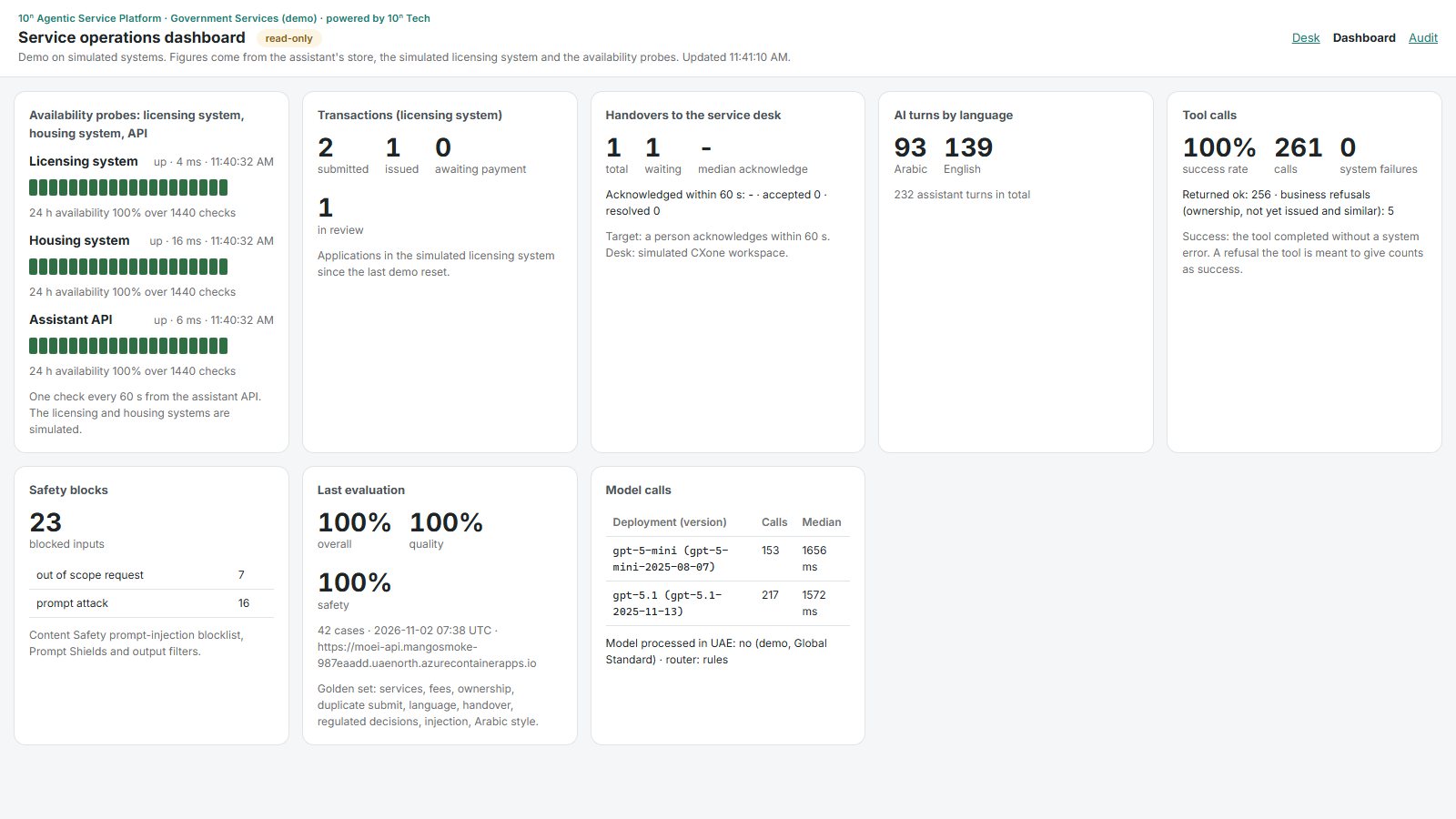
The case-management demo follows the UAE Design System; the government services demo opens in Arabic, right to left. Staff get an officer desk, an operations dashboard and an audit browser.
The production design, layer by layer. Our demo runs the agents, tools, PostgreSQL, Content Safety and Speech parts.
| Layer | Production design |
|---|---|
| Channels | Website and app chat, WhatsApp Business API, voice, officer desk |
| Edge | Web application firewall, Azure API Management |
| Agents | Microsoft Agent Framework (Python) on Azure Container Apps |
| Tools | Typed tools with approval modes, MCP server, filing outbox |
| Knowledge | Azure AI Search: keyword, vector and semantic |
| State and audit | Azure Database for PostgreSQL |
| Safety | Azure AI Content Safety with Prompt Shields, Arabic and English blocklists |
| Speech | Azure AI Speech, Arabic (UAE) and English |
| Keys and secrets | Azure Key Vault |
| Monitoring | OpenTelemetry, Application Insights, Azure Monitor |
Want to see it on your own service? We run the demo live with you, in Arabic or English.
Related: Agentic AI Platform, governance and audit, data residency and security, why enterprise AI agents stall between pilot and production.
Frequently asked questions
Is the platform locked to Azure?
The agents, tools and audit are ordinary containers and PostgreSQL, so we design them to move to an entity’s Kubernetes cluster. The Azure services (AI Search, Content Safety, Speech) have on-premises counterparts that we size per project.
Which language models do you use?
Whatever the deployment allows: large models on Azure for dialogue, smaller ones for routing, UAE-processed routes in production and open-weight models in on-premises designs. The gateway turns a change of model into a configuration change, followed by a full test run.
Why code and not a low-code agent builder?
Control of the tools, the approval checks and the audit record. Microsoft Copilot Studio suits internal assistants; a government transaction needs its write path in code that we can test case by case.
