Summary: AI agents for government entities in the UAE have to read the rules and records from the entity’s own systems, file only what the customer confirmed, hand the case to an officer with the whole conversation, and record every step. 10ⁿ Tech’s Agentic Service Platform does this in a demo we built for a federal government tender: one licence renewal, in Arabic or English, on the web, WhatsApp or voice, hosted in Azure UAE North on simulated government systems.
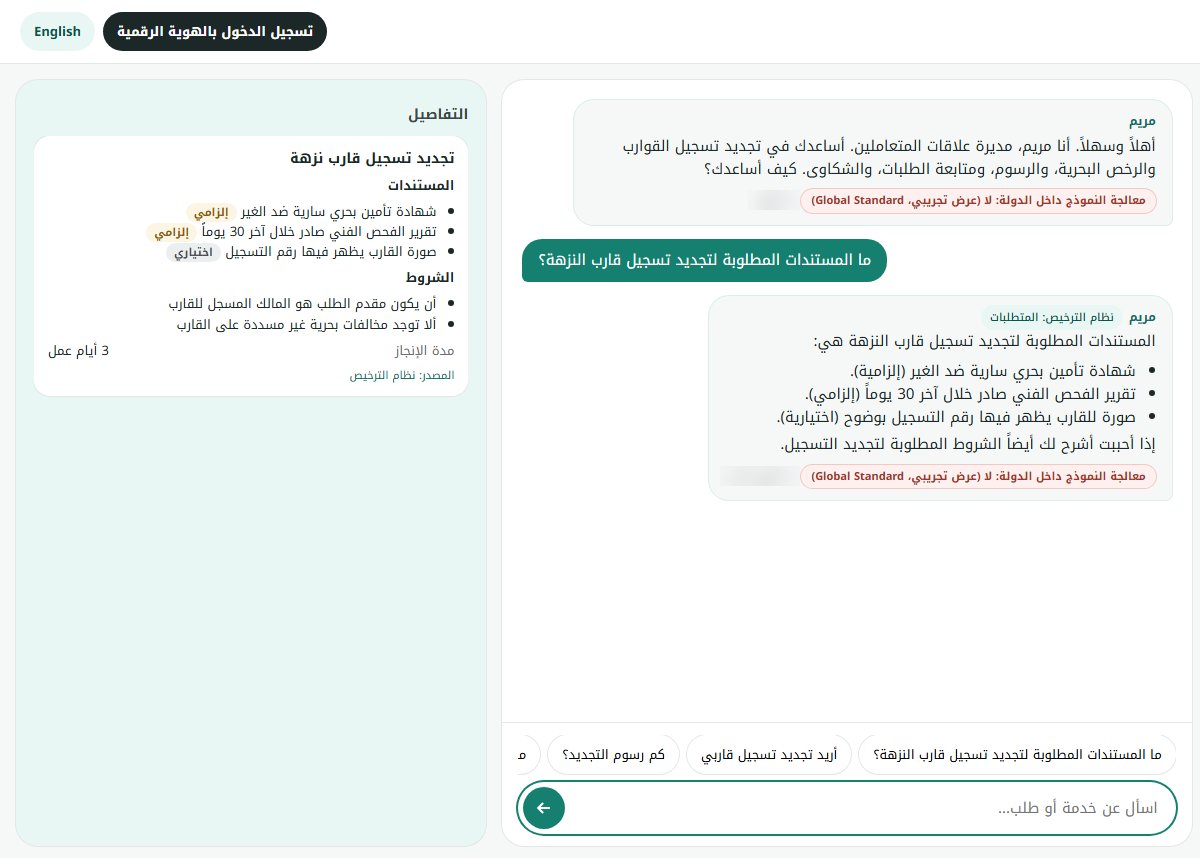
The customer types one plain sentence: they want to renew a registration. The assistant answers with the documents and conditions, read from the licensing system, and under the answer sits a small red badge: “Model processed in UAE: no (demo, Global Standard)”. Every answer in the demo carries it. We put it there so nobody has to ask.
The agent reads the rules first, and the customer’s records only after UAE PASS
A front-door agent works out which service the customer means and reads its requirements from the licensing system, each document marked mandatory or optional. The knowledge base holds descriptions only. Fees and rules come from the system of record through a tool, so a fee can’t drift from its source.
Personal records need identity. After UAE PASS sign-in (simulated in the demo), the agent reads only the records the licensing system returns for that Emirates ID; ask it to renew someone else’s record and it refuses. It flags anything that expires within 30 days, then prefills the application and labels every field with its source. A missing field shows as unknown, and the agent asks for it.
The customer approves the write, and the tool checks that approval
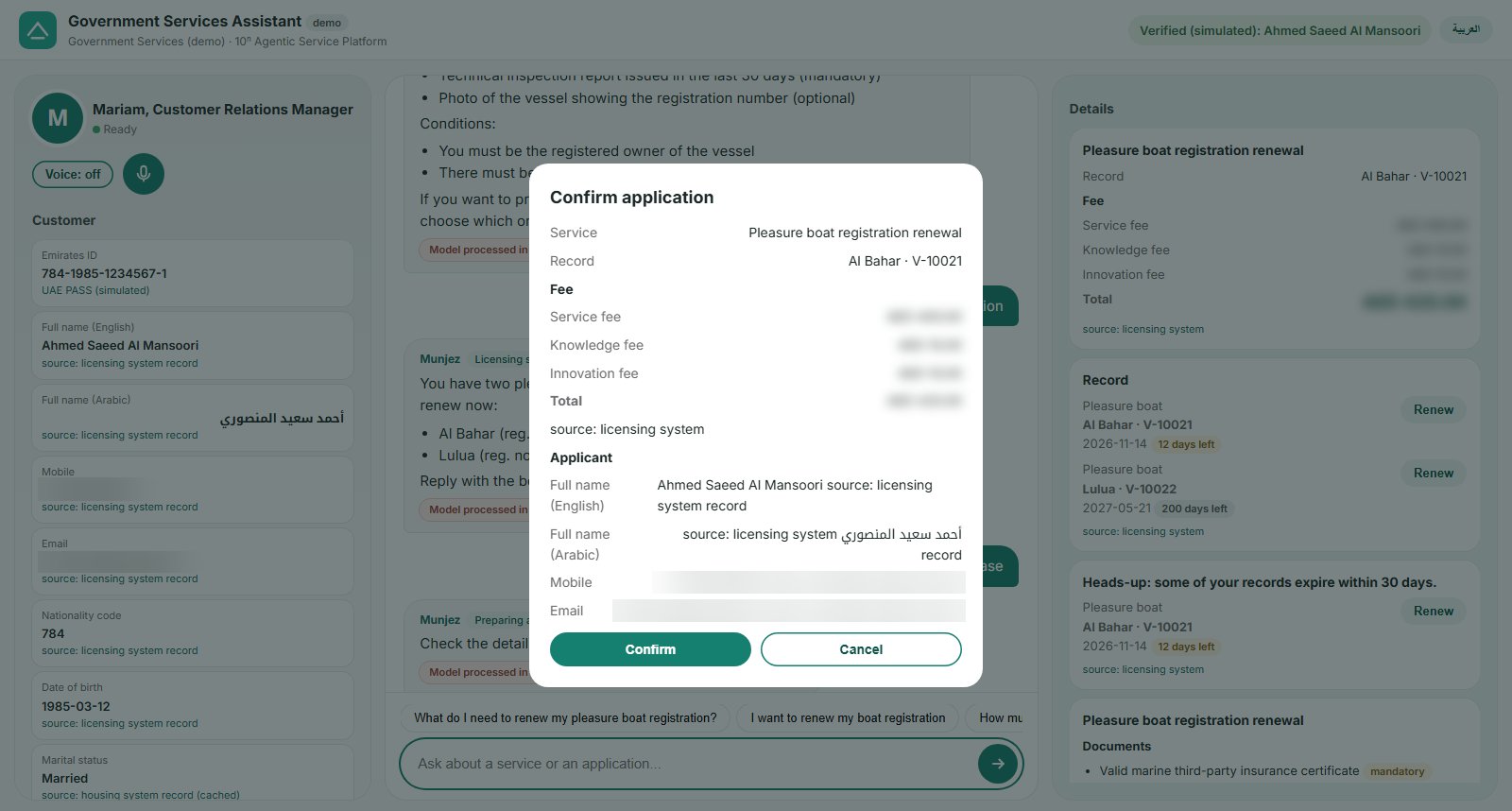
Each of the four tools that change state carries an “always require approval” mode. Nothing reaches the licensing system until the customer has checked the service, record, fee and prefilled fields and pressed Confirm. The tool also wants a UAE PASS step-up on the same session. Cancel answers “Cancelled. Nothing was sent to the authority’s systems” without calling a model.
Each draft travels with one idempotency key. After a timeout the tool looks the application up before it tries again, so asking twice returns the same application number. And an answer quoting a number the system did not issue is withheld and logged. That guard exists because, during testing, the model answered a cancelled confirmation by claiming a submission and making up a number.
The entity’s systems then price, decide and issue. The agent sends a link to the authority’s payment page (simulated here; its tools take no card data) and, later, the certificate in Arabic and English. Our case-management agents follow the same rule: see human-in-the-loop AI agents.
Six agents share the work, and none of them decides
| Agent role | Model | Tools that change state |
|---|---|---|
| Front door: service, requirements, records | larger language model | none |
| Transaction review: prepares and submits | larger language model | submit application, request certificate |
| Payments: fees and the payment link | smaller language model | request payment |
| Status and certificates | smaller language model | none |
| Complaints | larger language model | file complaint |
| Governance: reads the session’s audit trail | larger language model | none |
All six share one session, so context survives every handoff. They are six of the 17 roles in the demo’s registry; the other eleven are configured but not active. Routing runs on keyword rules: on a 14-turn test run, rules in place of a model call cut the median turn from 7.9 to 5.9 seconds.
An officer takes over inside the same chat
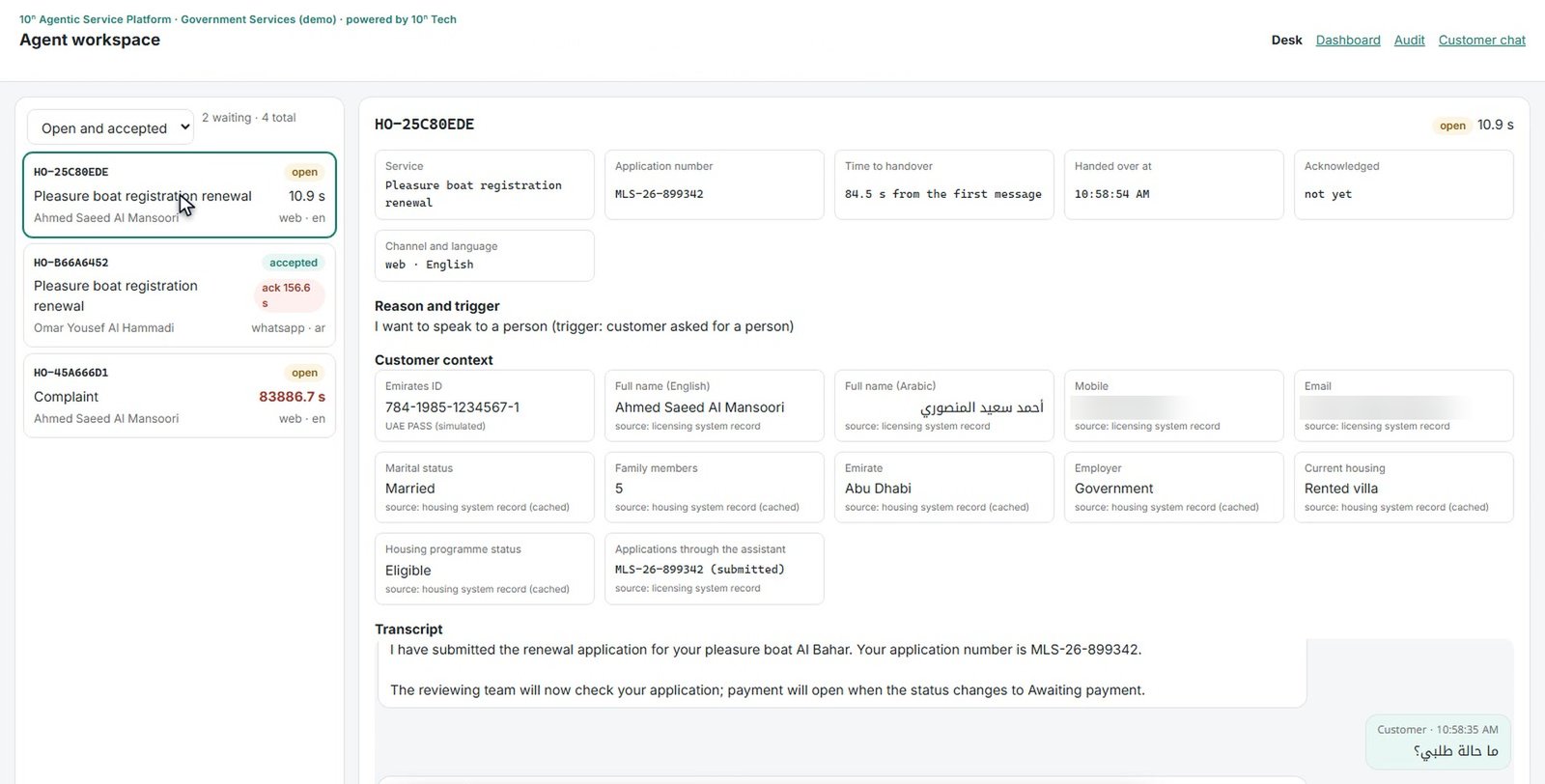
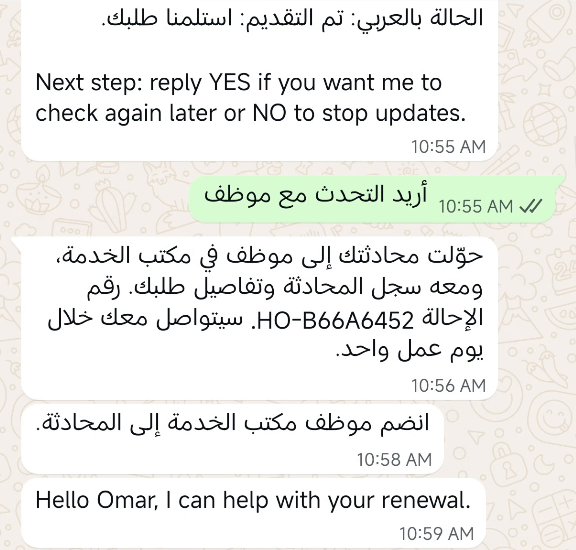
A customer who asks for a person, escalates a complaint or hits the same failure three times goes to the service desk. The officer sees the transcript, identity, service, application number and reason, and accepting the case records the acknowledgement time against a 60-second target. Until the officer resolves the case, the customer’s messages go to the officer and the replies land in the customer’s chat.
The desk times the officer too, and it isn’t kind about it. In the still below, one WhatsApp handover took 156.6 seconds to acknowledge, and its badge is red. In production the handover would go to the entity’s own contact-centre platform; the demo desk imitates one.
WhatsApp and voice continue the same session
The session, the draft and its idempotency key live on the platform, not in a channel. On WhatsApp the agents take text and voice notes; Azure AI Speech in UAE North transcribes the notes, and the answer comes back in text and voice. A step that needs identity sends a secure sign-in link that expires after 30 minutes. A confirmation takes a plain YES or NO.
The phone number links WhatsApp and calls to one customer, so switching channel keeps the same application and never files it twice. A write on the new channel still asks for UAE PASS again. In the browser, a call button starts a spoken conversation with the same agents, tools and audit.
Every model call and tool call is in the audit trail
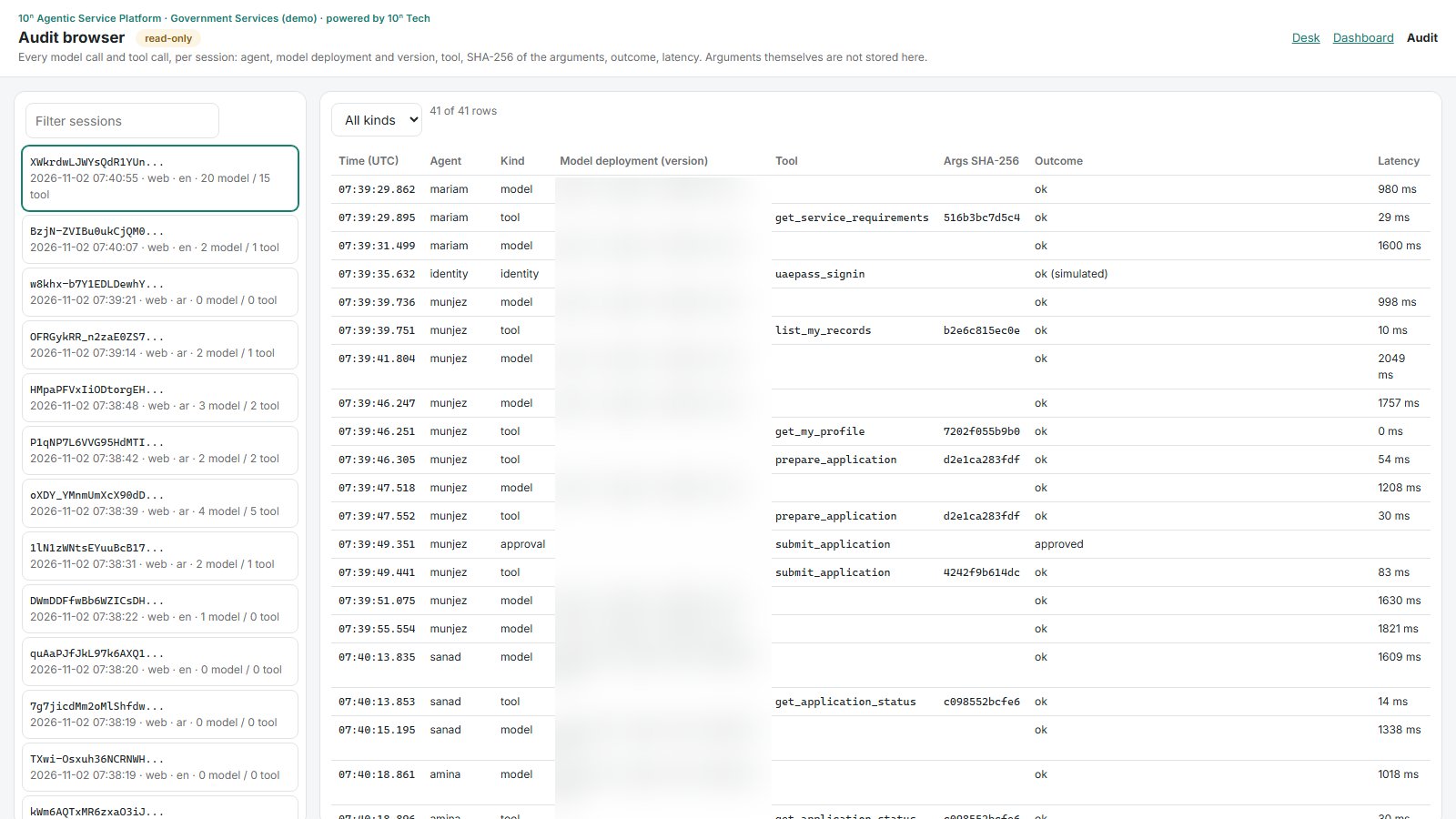
Each model call is recorded with the deployment and the model version the service returned. Each tool call gets the calling agent, a SHA-256 hash of its arguments, the outcome and the latency; the payload itself stays in the filing outbox. The operations dashboard shows transactions, handovers, safety blocks and the last evaluation.
That evaluation passed 42 of 42 cases in Arabic and English, 24 on quality and 18 on safety, with code checks and no model judge. The first run had passed 79.2% of quality cases and 94.1% of safety cases. Median server time is 2.8 seconds per turn, p90 4.8 seconds.
What this demo lacks: audit rows chained by hash, a stop switch, a release gate and a second approver for officer decisions. We built those in another of our demos. This one doesn’t have them yet, and a buyer should hear that from us first.
AI agents for government entities in the UAE must say where the data goes
On 23 April 2026 the UAE Cabinet announced a framework to run half of government sectors and operations on agentic AI within two years. The National Committee for Agentic AI followed in August 2026 with an operating framework and a government experience design guide, in Arabic. We design each service against both: UAE PASS before personal data, Arabic first, a human alternative for every service and a person accountable for each decision.
The platform runs in Azure UAE North: agents, tools, records, audit and speech. Where the language model processes data depends on the deployment type, not on the account’s region. The demo uses global deployments, which may process data outside the UAE, so it holds fictional data only and says so on every answer. Production uses a UAE-processed route: regional provisioned capacity in UAE North or a UAE sovereign cloud endpoint.
Two channels cross the border by their nature. WhatsApp messages pass through Meta and a WhatsApp Business provider, and the browser voice service runs outside UAE North. The entity decides which services use them; our data residency page lists every part and where it runs.
What to check before you commission AI agents for a government service
- Ask where fees and rules come from. The answer should be the system of record, through a tool.
- Watch a write: the customer confirms the exact details, and the tool refuses to file without that confirmation and a UAE PASS step-up.
- Submit the same application twice. The second answer must carry the first number.
- Ask for a person mid-transaction. The officer should see the transcript and the application, and reply inside the customer’s chat.
- Open one audit row. It should name the agent, the model version and the outcome, with the arguments hashed.
- Ask which parts process data outside the UAE (model route, WhatsApp, voice), and get the answer in writing.
Frequently asked questions
Does the AI agent approve applications?
No. The agent prepares, checks and files; the entity’s systems and staff decide. A request to waive a fee or approve one’s own application, in Arabic or English, is caught by the input screen before any model call.
Is the demo connected to real government systems?
No. The licensing and housing systems, UAE PASS screen, payment page and officer desk are simulated, every person, record and fee in them is fictional, and the certificate carries a “simulated” banner. In production the agents would connect through the entity’s published interfaces, and UAE PASS needs onboarding with the entity.
Can the platform run on our own servers?
Yes, by design: agents and tools on the entity’s Kubernetes cluster, open-weight models on its GPU servers, search and storage inside its network. WhatsApp and third-party voice drop out, and we size each on-premises deployment as its own project.
Does every service need its own build?
No. Most government services are the same few transaction types on one record: issue, renew, modify, replace and cancel. Services that share a type share one template, each with its own rules and acceptance tests.
Next step
We run the demo live with you, in Arabic or English, including your attempts to break it. See AI agents for government services, or get in touch.
