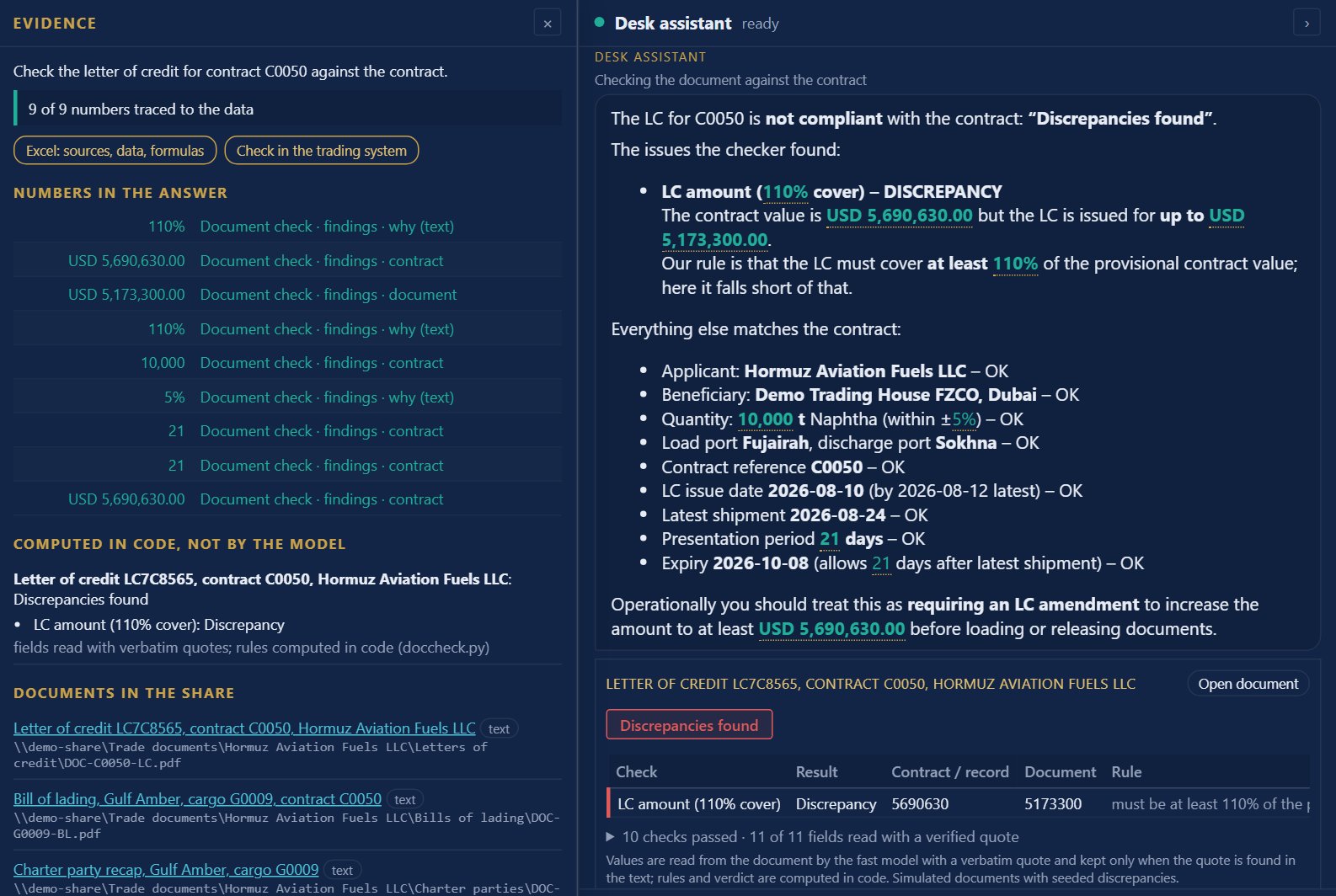
Summary: Explainable AI for commodity trading means a trader can see where every figure in an answer came from. In the Trader Intelligence Desk, the AI assistant 10ⁿ Tech built for commodity trading desks, each number in an answer is traced to a table cell, a computed field, the question, a table total or an earlier answer, and a number found nowhere is marked amber for a person to check. The trading book, its counterparties, the trade documents and the trading system in the demo are simulated.
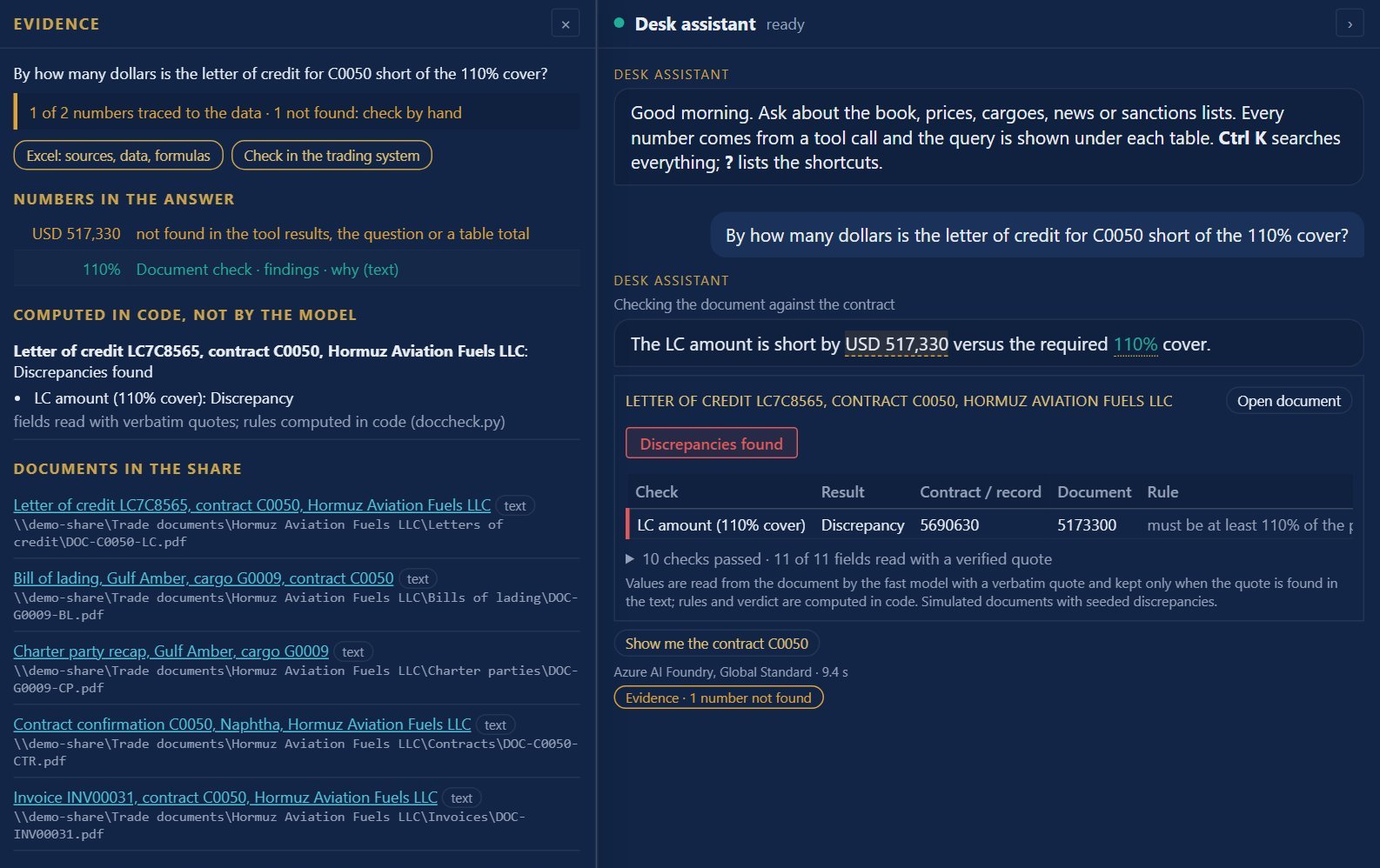
“Evidence · 1 number not found.”
That line sat under the desk’s answer when we asked by how many dollars the letter of credit for contract C0050 falls short of 110% cover. The answer said USD 517,330, with an amber dashed line under the figure.
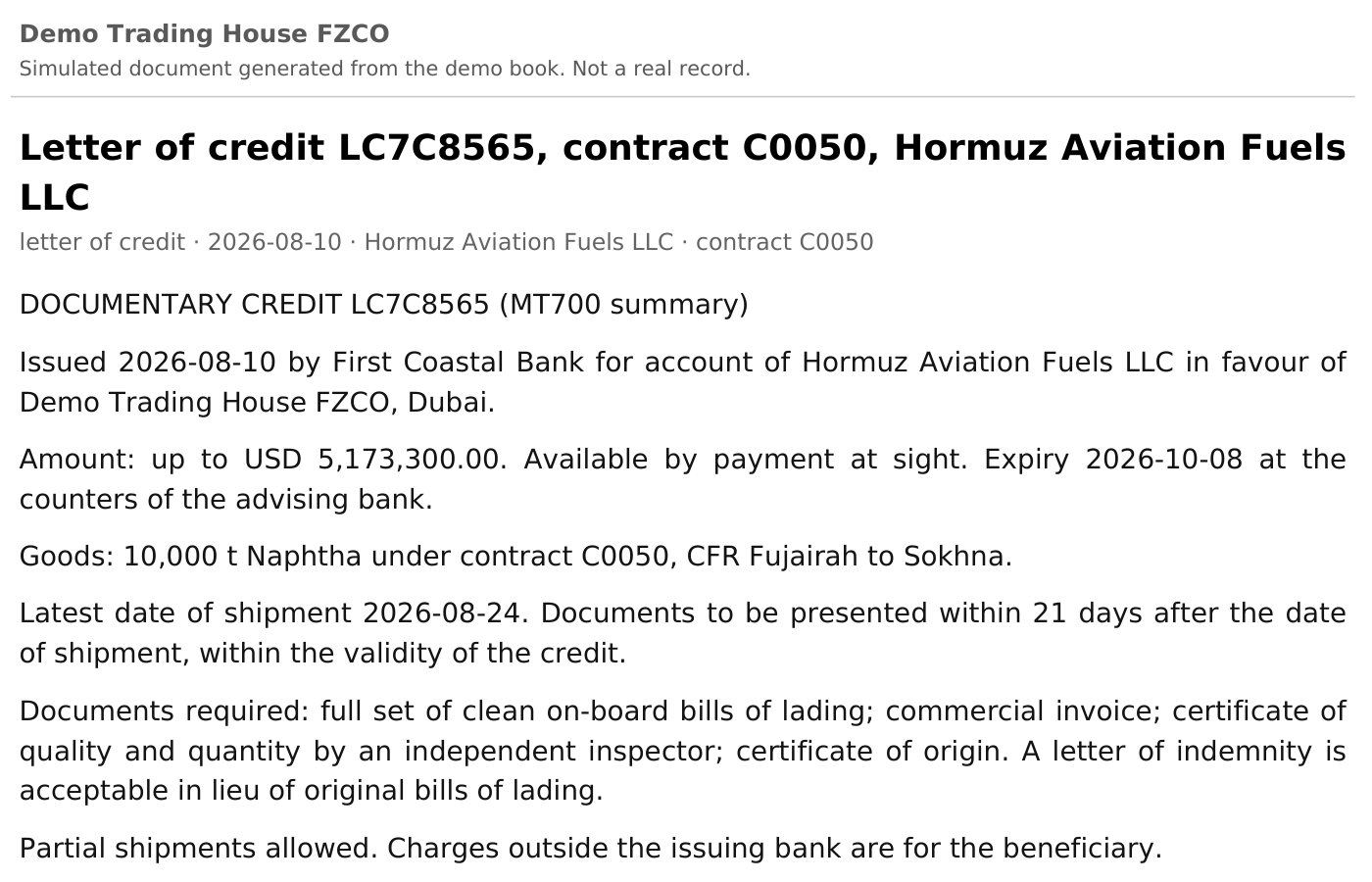
The sum is right. The contract needs USD 5,690,630.00 of credit and the LC is for up to USD 5,173,300.00. But no tool returned 517,330: the language model did that subtraction itself, and the desk won’t vouch for arithmetic it can’t find in the data. So it hands the figure to a person.
Explainable AI for commodity trading means each number has an address
The desk stores each answer next to every tool result it used: query rows, document-check results, sanctions entries, prices, news. Fixed code then reads each number in the answer and looks for it in that evidence, strongest source first: a table cell or a field a tool returned, the trader’s question, a row count or column total, and the results behind earlier answers in the conversation.
Rounding is allowed, to the precision the answer shows:
def _matches(n, v):
    target = n["value"] * n["mult"]
    tol = 0.5 * (10 ** -n["decimals"]) * n["mult"]
    return abs(abs(v) - target) <= tol + 1e-9 * max(1.0, target)
So “USD 5.2m” matches 5,173,300, since one decimal place in millions leaves 50,000 either way. “USD 5,173,000” does not: it claims to be exact to the dollar and is 300 dollars off. Dates, years and list markers are skipped. A table cut at 60 rows offers no column total, because a total over part of a table is no total.
A desk acts only on numbers it can check
Our working assumption: a desk will not act on an AI answer it cannot check. Letters of credit show why. ICC figures, reported by Trade Finance Global in 2022, put the share of documentary credits that are discrepant on first presentation at 65-80%.
Models also misread numbers they are handed. In an earlier test round, with correct SQL underneath, the model confused “overdue” with “over limit” two times out of three, until a status column spelled out in words fixed it. The trace is for the mistakes a fix like that misses. And a risk team gets something to file: each answer is stored with its question, tool results, model and time, and the Excel workbook below is a copy to keep.
Amber means check it by hand, even when the sum is right
Each traced number gets a dotted underline in the answer. Click it and the evidence drawer opens on that number’s row. A number found nowhere gets an amber dash, and the button under the answer reads “Evidence · 1 number not found” instead of “Evidence · 9/9 numbers traced”.
Amber is rare when the tools do the work. On our own 61-question test set, run against the deployed demo on Azure, 337 of 341 numbers in the answers were traced. Three of the four misses were a “30” from “30 days”. The fourth, 5.6m, appeared in the model’s summary of a news item and in no tool result. The set reruns on every release (how we evaluate agents).
The desk’s design rule applies here: code does the arithmetic, the model writes the sentence. When the model calculates anyway, the answer still arrives, flagged. (For a shortfall a desk cares about, the proper fix is to have the checker compute it, so it traces like everything else.)
The drawer opens the document behind the figure
Below the numbers, the drawer groups the evidence: checks computed in code, the tables the assistant read with their SQL and row counts, trade documents, news links, prices and sanctions entries with their list and programme.
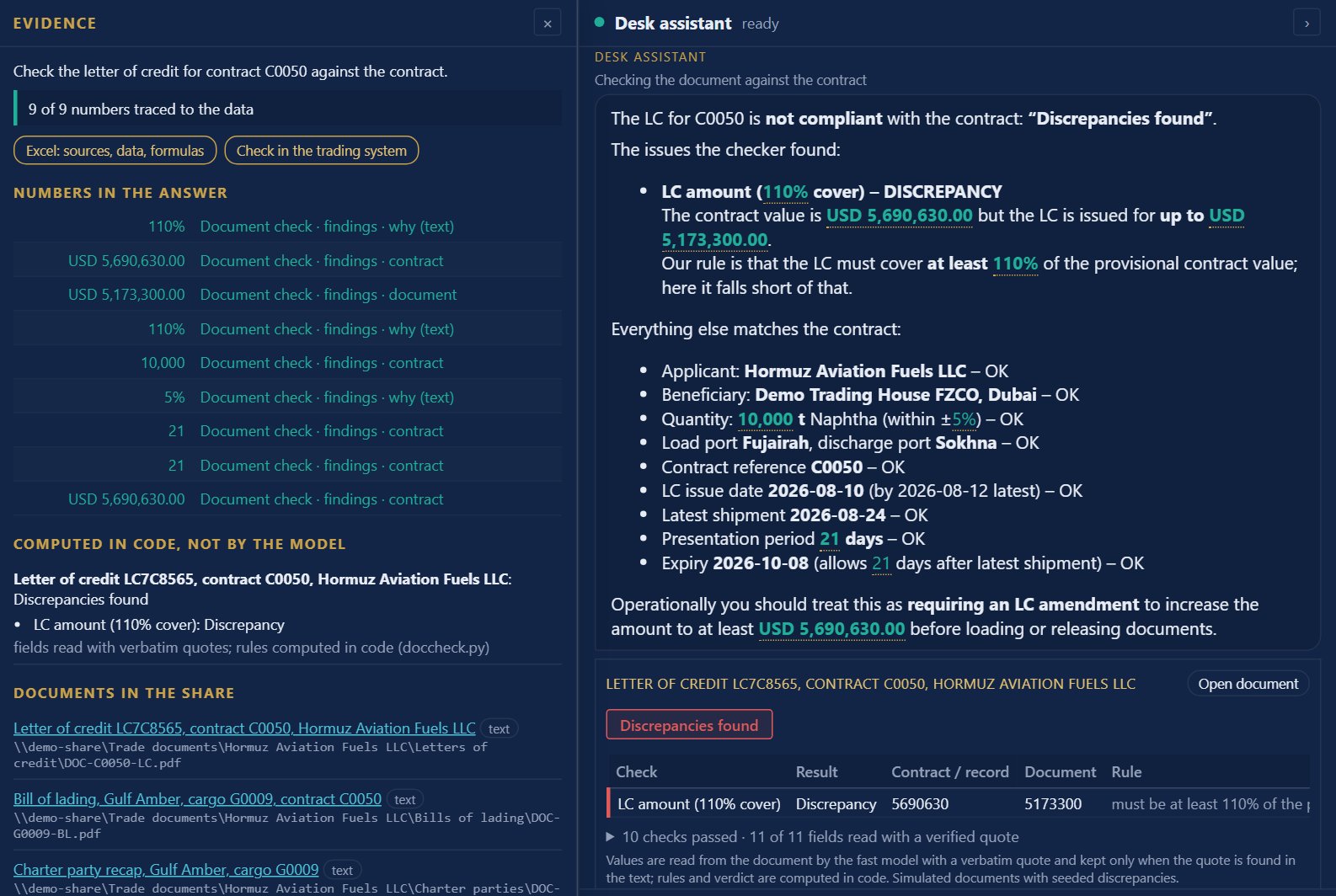
For the LC check, a smaller language model reads each field from the letter of credit, and a value counts only if its verbatim quote is found in the text. Rules and verdict are computed in code. On C0050 that gave 10 checks passed, one discrepancy and 11 of 11 fields read with a verified quote.
Each document opens as a PDF from a read-only share, under a path like \\demo-share\Trade documents\{counterparty}\Letters of credit\. In the demo the share is simulated, and every page says so in its header.
The Excel workbook recomputes the check with live formulas
Every answer comes with a workbook: a Numbers sheet linking each figure to its source cell, the query results, the sources, and a sheet for each check computed in code. On the document-check sheet, the 110% rule is an Excel formula over the contract’s quantity and price:
=IF(D16>=ROUND($B$7*$B$8*1.1,2)*0.995,"ok","discrepancy")
A Match column compares Excel’s result with the desk’s and shows OK or DIFF. Our tests alter one desk value in each of four workbook copies, and Excel must show DIFF in every one.
The trading-system check re-reads the record
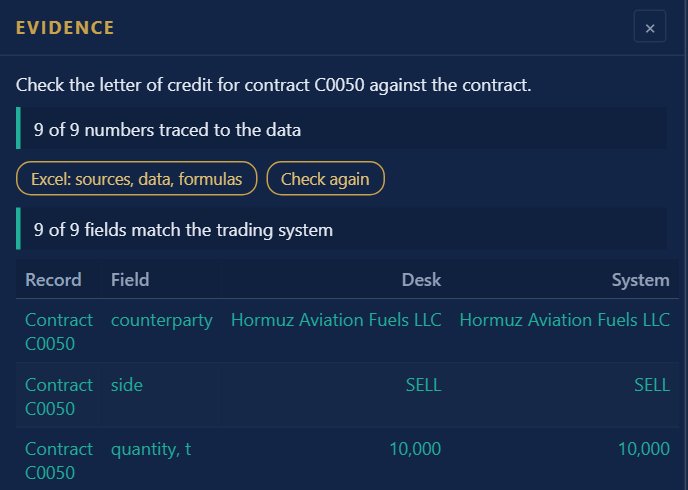
The last button, “Check in the trading system”, fetches the contracts, invoices, cargoes and counterparties named in the answer again through the trading system’s API and compares each field the desk showed. For C0050, 9 of 9 fields matched.
In the demo, that trading system reads the same database as the desk. So the check proves the assistant’s query and arithmetic, and says nothing about whether the desk’s copy of the data matches the source. At a client, the same button would call the client’s own system.
What tracing does not prove
A traced number was found in the data. Whether it answers the question is a separate test, and the tracer does not run it. One Arabic question in our set asks for the net position by product. In 2 of 3 runs the model answered from the current month’s view instead of the whole book, and all 6 numbers in that answer traced cleanly. It is the one failure in the 61 (60 passed).
Matching is by value. A “21” in an answer will trace to any 21 among the tool results, which is why the code ignores bookkeeping fields and never traces whole numbers under 100 to an earlier answer.
And the documents are simulated. The checks have not yet met a client’s real letter of credit, let alone a scanned one.
What to check before you commission an AI assistant for a trading desk
- Ask for the trace of one answer: every number, with its source.
- Ask for a subtraction no tool performs, and watch what the desk marks.
- Click a number, open the original document read-only, and find the quoted line.
- Download the workbook, recalculate it in Excel, then change one value and look for DIFF.
- Ask what the system check re-reads: your trading system, or the copy the assistant already used.
- Ask for the traced count across the test set, and for the answers whose numbers traced but missed the question.
Frequently asked questions
What does “traced” mean for a number in an answer?
It was found, within the rounding the answer shows, in the evidence behind that answer, and the drawer names where. A traced number can still answer the wrong question.
Why would a correct number show amber?
Because no tool returned it. When the model does its own arithmetic, the result appears in no tool output, so the desk marks it for a person. Amber means unverified, and the figure may well be right, as USD 517,330 was.
Does the evidence drawer work with our own documents and trading system?
It is built for them, but it has not met real records yet. In the demo the book, the counterparties, the documents and the trading system are simulated. At a client the check would call the client’s own system, and the documents would come from the client’s own share.
Who builds AI assistants for commodity trading desks in Dubai?
10ⁿ Tech, a Dubai company, built the Trader Intelligence Desk shown here. The demo app runs on Azure in the UAE North region, with model calls on a global Azure deployment, and reads the book, trade documents, prices, news, ship positions and sanctions lists. Prices, news, ship positions and sanctions lists are real; the trading book is simulated.
Next step
If your desk wants AI answers it can audit, we can run a live session on the simulated book and then scope a pilot on your own extract. Our earlier post on AI for commodity trading desks covers the data join behind it, or get in touch.
